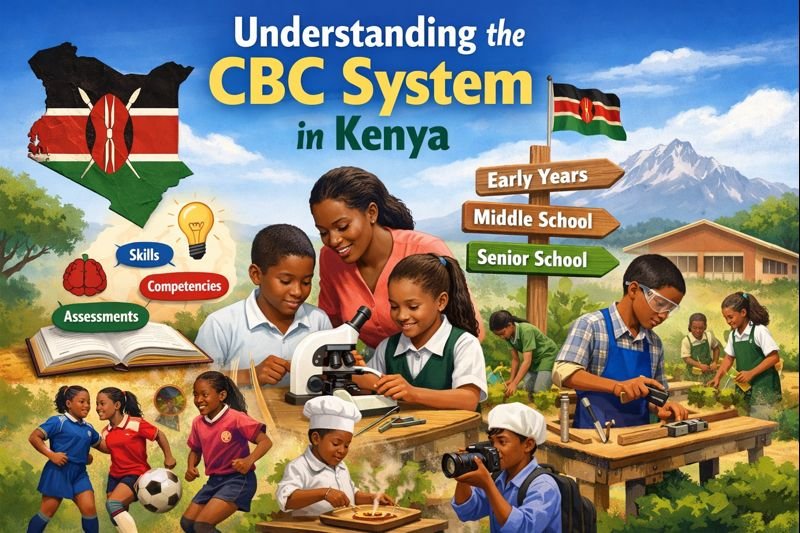
The CBC system in Kenya has transformed how children learn across the country since its introduction in 2017. If you’re a parent, teacher, or student trying to understand this new approach to education, you’re not alone. Many Kenyans still have questions about how CBC works, what makes it different from the old 8-4-4 system, and what it means for learners’ futures.
What is CBC in Kenya? The Competency-Based Curriculum (CBC) is an education framework that focuses on developing skills, knowledge, and attitudes in learners rather than just memorizing facts for exams. Designed by the Kenya Institute of Curriculum Development (KICD) and implemented by the Ministry of Education, CBC aims to prepare children for the modern world by nurturing talents, building critical thinking abilities, and encouraging hands-on learning.
This article explains everything you need to know about the CBC system in Kenya—from how it works in classrooms to what parents and teachers should expect at each level.
CBC Meaning and Core Philosophy
What Does CBC Stand For?
CBC stands for Competency-Based Curriculum. The word “competency” refers to the ability to apply knowledge, skills, and attitudes to real-life situations. Unlike traditional education systems that measure success mainly through exams, CBC focuses on what learners can actually do with what they’ve learned.
The CBC Education Explained
The CBC education system is structured around seven key competencies that every Kenyan learner should develop:
- Communication and collaboration – Working well with others and expressing ideas clearly
- Critical thinking and problem-solving – Analyzing situations and finding solutions
- Creativity and imagination – Thinking of new ideas and approaches
- Citizenship – Understanding rights, responsibilities, and national values
- Digital literacy – Using technology effectively and safely
- Learning to learn – Knowing how to acquire new knowledge independently
- Self-efficacy – Believing in one’s ability to succeed
These competencies are woven into every subject and activity, ensuring that learners don’t just pass exams but become well-rounded individuals ready for work, entrepreneurship, or further studies.
Core Values in CBC
CBC also emphasizes seven core values that guide learners’ behavior and character development:
- Love
- Responsibility
- Respect
- Unity
- Peace
- Patriotism
- Integrity
These values are not taught as separate subjects but are integrated into daily school activities, helping children become responsible citizens.
How the CBC System Works in Kenya
The 2-6-3-3-3 Structure
The CBC system in Kenya follows a 2-6-3-3-3 structure, which replaces the old 8-4-4 format. Here’s what each number represents:
2 years – Pre-Primary Education
- Pre-Primary 1 (PP1) for children aged 4-5 years
- Pre-Primary 2 (PP2) for children aged 5-6 years
- Focus on play-based learning, basic literacy, and numeracy
6 years – Primary School (Grades 1-6)
- Lower Primary: Grades 1, 2, and 3
- Upper Primary: Grades 4, 5, and 6
- Learners study core subjects and begin exploring their interests
- Assessment is continuous, not just through end-of-term exams
3 years – Junior Secondary (Grades 7-9)
- Learners continue with core subjects
- They choose elective subjects based on their interests and abilities
- More emphasis on practical skills and projects
- Ends with a Kenya Junior Secondary Education Assessment (KJSEA)
3 years – Senior Secondary (Grades 10-12)
- Learners specialize in career pathways: STEM, Social Sciences, Arts & Sports, or Technical & Vocational
- Prepares students for university, technical colleges, or direct employment
- Ends with a Kenya Certificate of Secondary Education (KCSE)
3 years – Tertiary Education
- University degree programs
- Technical and Vocational Education and Training (TVET) courses
- Other higher education options
Learning Areas and Subjects
In CBC, traditional “subjects” are called learning areas. In primary school, these include:
- English Activities (or Kiswahili Activities, depending on language of instruction)
- Kiswahili Language Activities (or English Language Activities)
- Mathematics Activities
- Environmental Activities (integrates Science and Social Studies)
- Religious Education Activities
- Movement and Creative Activities (Physical Education, Music, Art)
In Junior Secondary, subjects become more defined and learners can choose from options like Agriculture, Business Studies, Computer Science, Foreign Languages, Performing Arts, and more.
Assessment in CBC
One of the biggest changes in the CBC system is how learners are assessed. Instead of relying solely on end-of-term exams, CBC uses:
- Formative Assessment – Ongoing evaluation during lessons through questions, observations, and activities
- Summative Assessment – End-of-term tests that check overall understanding
- Learning Portfolios – Collections of learners’ work showing progress over time
- Competency-Based Grading – Learners are rated as “Exceeding Expectations,” “Meeting Expectations,” “Approaching Expectations,” or “Below Expectations” rather than just receiving percentage scores
This approach gives a fuller picture of what a child can do, not just what they can remember for an exam.
How CBC Works in Kenyan Classrooms
Teaching Methods
Teachers in the CBC system use different methods compared to the old system:
Learner-Centered Approach Instead of the teacher talking while students listen, CBC encourages learners to participate actively. Students ask questions, work in groups, and solve problems together.
Practical Activities Lessons include hands-on tasks. For example, in a Mathematics lesson about measurement, learners might measure classroom objects rather than just reading about measurements in a textbook.
Integration of Subjects CBC connects different learning areas. A lesson about farming might include science (plant growth), mathematics (calculating yields), and social studies (importance of agriculture in Kenya).
Use of Learning Resources Teachers use locally available materials—stones for counting, leaves for art, community members as guest speakers—making learning relevant to learners’ environments.
Role of Parents
Parents play a crucial role in CBC. The curriculum encourages parents to:
- Support homework and projects
- Attend school meetings to understand their child’s progress
- Provide materials for practical activities
- Encourage children to explore their talents at home
- Monitor continuous assessment reports
Many schools now hold regular parent forums where teachers explain what learners are doing and how parents can help.
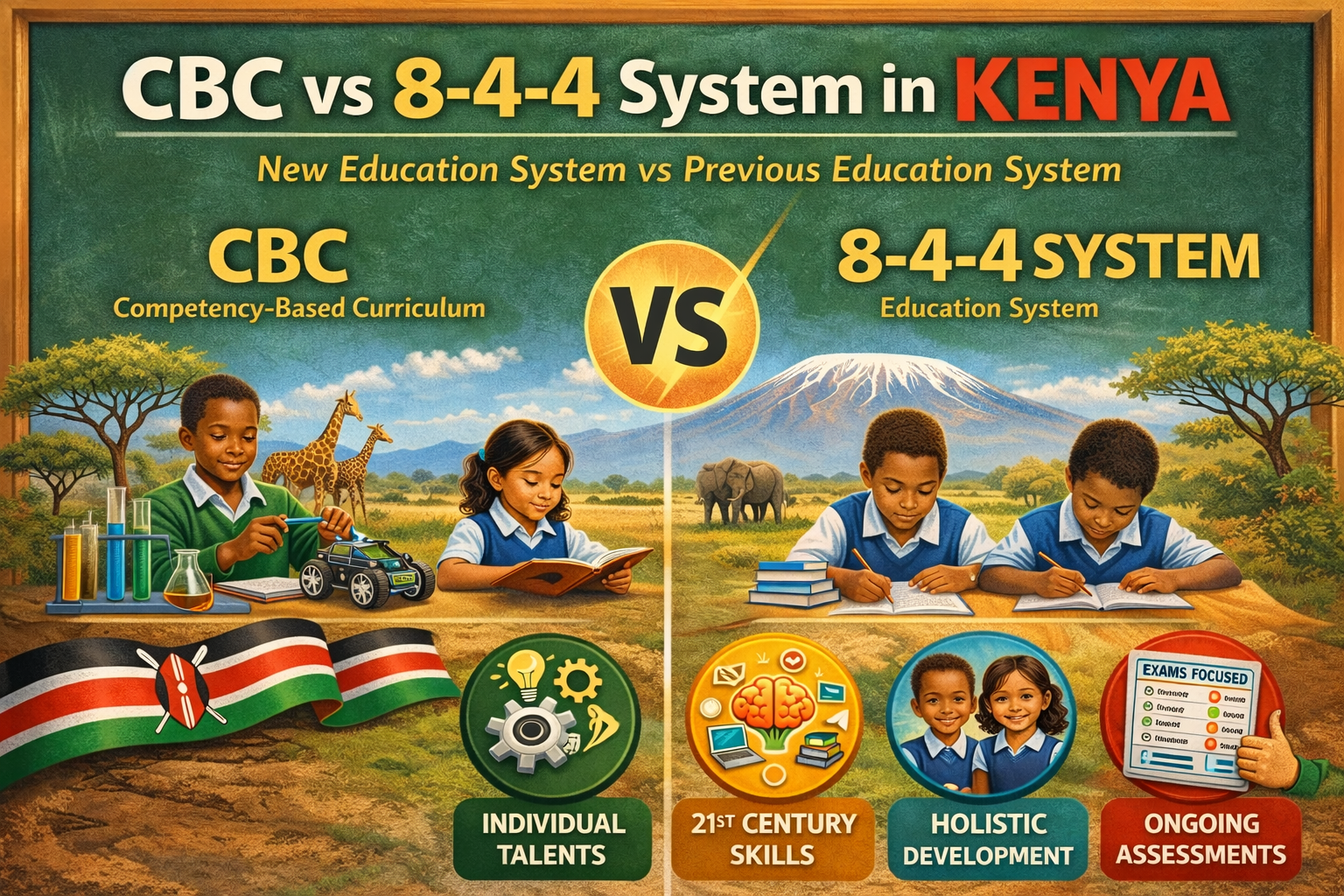
CBC vs 8-4-4: Key Differences
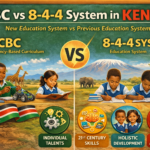
Understanding the differences between CBC and the previous 8-4-4 system helps clarify why Kenya made this change.
Structure
8-4-4 System:
- 8 years of primary school
- 4 years of secondary school
- 4 years of university
- Total: 16 years
CBC System:
- 2 years pre-primary + 6 years primary + 3 years junior secondary + 3 years senior secondary + 3 years tertiary
- Total: 17 years (but learning starts earlier)
Focus
8-4-4:
- Emphasized memorization and passing exams
- One national exam (KCPE) determined secondary school placement
- Limited focus on practical skills
- All students followed the same path until Form 3
CBC:
- Emphasizes competencies and skills
- Continuous assessment throughout schooling
- Strong focus on talents, interests, and career pathways
- Learners begin specializing from Grade 7
Assessment
8-4-4:
- Heavily exam-oriented
- High-stakes national exams (KCPE and KCSE)
- Percentage grading
CBC:
- Continuous assessment
- Multiple checkpoints instead of one major exam
- Competency-based grading
- Learning portfolios
Career Preparation
8-4-4:
- Mainly prepared students for white-collar jobs
- Less emphasis on technical and vocational skills
- Many graduates lacked practical job skills
CBC:
- Prepares learners for diverse career paths
- Strong TVET (Technical and Vocational Education and Training) integration
- Emphasis on entrepreneurship and self-employment
- Learners can enter the job market at different levels
Benefits and Importance of the CBC System
For Learners
Talent Development CBC recognizes that children have different strengths. A child who struggles with mathematics might excel in music or sports, and CBC provides space to develop these talents.
Real-World Skills Learners develop problem-solving, teamwork, and communication skills that employers value. They don’t just learn facts—they learn how to apply knowledge.
Reduced Exam Pressure With continuous assessment, learners aren’t judged solely on one exam’s results. This reduces anxiety and gives children multiple opportunities to demonstrate their abilities.
Early Career Guidance By Grade 7, learners begin exploring career pathways, helping them make informed choices about their futures rather than deciding everything after secondary school.
For Parents
Better Understanding of Child’s Progress Regular assessment reports show specific competencies, helping parents see exactly where their child excels and where they need support.
Active Participation CBC invites parents into the learning process, strengthening the home-school connection.
Holistic Development Parents can see their children growing not just academically but also in character, values, and life skills.
For Kenya’s Economy
Skilled Workforce CBC produces graduates with practical skills that match job market needs, reducing unemployment among youth.
Innovation and Entrepreneurship By nurturing creativity and critical thinking, CBC prepares a generation of innovators who can create solutions to Kenya’s challenges.
Alignment with Vision 2030 CBC supports Kenya’s development goals by producing competent citizens ready to contribute to the nation’s growth.
Challenges and Common Concerns
Infrastructure and Resources
Many schools, especially in rural areas, lack adequate facilities for practical CBC lessons. Science labs, computer rooms, and sports equipment are often insufficient. The government and stakeholders continue working to address these gaps, but progress varies across counties.
Teacher Preparedness
CBC requires teachers to use new methods, and not all educators received sufficient training initially. Some teachers still struggle to move away from the teacher-centered approach they used in 8-4-4. Ongoing professional development is essential.
Parent Understanding
Many parents don’t fully understand CBC because they were educated under a different system. This sometimes leads to frustration or confusion about homework, assessment, or curriculum expectations. Schools need to continue educating parents about CBC.
Transition Challenges
The first cohorts of CBC learners face unique challenges as systems are still being refined. Questions about junior secondary placement, infrastructure, and pathways to tertiary education have required continuous policy adjustments.
Cost Implications
Some parents worry about the cost of materials for practical activities or the longer education cycle (17 years vs. 16 years). However, the Ministry of Education has stated that CBC should not be more expensive than 8-4-4, and free primary education policies still apply.
Assessment Complexity
Some teachers and parents find CBC’s assessment system more complex than simple percentage scores. Understanding what “Approaching Expectations” means in Mathematics versus English requires more interpretation.
What Parents Should Know
Supporting Your Child at Home
Create a Learning Environment Set aside space and time for homework and projects. Encourage your child to practice skills learned in school.
Attend School Meetings Don’t miss parent meetings where teachers explain CBC progress. Ask questions if you don’t understand assessment reports.
Encourage Exploration Let your child try different activities—sports, music, art, coding—to discover their talents.
Don’t Compare to 8-4-4 Avoid saying “in our time” when discussing your child’s education. CBC is different by design, and comparisons can confuse your child.
Monitor Screen Time While digital literacy is important, ensure your child uses technology for learning, not just entertainment.
Understanding Assessment Reports
CBC reports look different from what you may remember. Instead of just seeing “75% in Math,” you’ll see statements like “The learner can solve multi-step word problems involving fractions – Exceeding Expectations.”
Take time to read each competency statement. If your child is “Below Expectations” in an area, work with the teacher to create a support plan.
Choosing Career Pathways
When your child reaches Grade 7, they’ll begin choosing elective subjects. This is an important decision, but it’s not final. Help your child explore options based on their interests and strengths, not just what you think is prestigious.
Remember that all pathways—STEM, Arts, Technical, or Social Sciences—lead to valuable careers. Kenya needs doctors, but also needs carpenters, artists, and farmers.
What Teachers Should Know
Effective CBC Implementation
Plan for Active Learning Every lesson should include activities where learners do something, not just listen. Use group work, experiments, role-plays, and discussions.
Use Local Resources You don’t need expensive materials. Use stones, sticks, local plants, and community resources to make lessons practical and relevant.
Maintain Learning Portfolios Keep organized records of each learner’s work throughout the term. This makes assessment easier and shows progress clearly.
Collaborate with Colleagues Share lesson ideas and challenges with fellow teachers. CBC is new for everyone, and collaboration helps solve problems.
Communicate with Parents Send regular updates about what learners are doing. Explain how parents can support learning at home.
Professional Development
Take advantage of training opportunities offered by KICD, the Teachers Service Commission (TSC), or your school. Stay updated on CBC changes and best practices through official channels.
What Students Should Know
Making the Most of CBC
Participate Actively Don’t be afraid to ask questions, share ideas, or make mistakes. CBC values your participation, not just right answers.
Explore Your Interests Try different activities to discover what you enjoy. You might surprise yourself with hidden talents.
Work with Others Group projects teach you teamwork—an important skill for any career. Be a good team member.
Keep Your Portfolio Organized Your portfolio shows your progress. Take pride in your work and keep it neat.
Think About Your Future Start thinking about what you might like to do after school. Talk to parents, teachers, and people in different careers.
Managing Stress
Even though CBC reduces exam pressure, school can still feel stressful. Talk to teachers or parents when you feel overwhelmed. Remember that everyone learns at their own pace, and CBC recognizes different strengths.
Frequently Asked Questions (FAQs)
What exactly is CBC in Kenya?
CBC (Competency-Based Curriculum) is Kenya’s current education system that focuses on developing skills, knowledge, values, and attitudes in learners. It replaced the 8-4-4 system in 2017 and follows a 2-6-3-3-3 structure, emphasizing practical learning and continuous assessment rather than relying mainly on exams.
How is CBC different from 8-4-4?
CBC differs from 8-4-4 in several ways: it includes pre-primary as part of basic education, uses continuous assessment instead of high-stakes national exams, focuses on competencies rather than just content mastery, allows learners to choose career pathways from Grade 7, and emphasizes practical skills and talent development throughout schooling.
When will the first CBC students complete secondary school?
The first CBC cohort started Pre-Primary 1 in 2017. Following the 2-6-3-3-3 structure, these learners will complete senior secondary (Grade 12) in 2029, when they will sit for the reformed Kenya Certificate of Secondary Education (KCSE) examination.
Is CBC more expensive than 8-4-4 for parents?
CBC should not be significantly more expensive for parents. The government provides free primary education, and policies are in place to ensure CBC remains affordable. While some practical activities require materials, schools are encouraged to use locally available resources. The main difference is that education now starts at age 4-5 (Pre-Primary), so parents begin paying for schooling slightly earlier.
What if my child doesn’t perform well in exams under CBC?
CBC assesses learners continuously, not just through exams. If your child struggles with written tests, they might excel in practical activities, projects, or oral presentations. Work closely with teachers to understand where your child needs support and what their strengths are. CBC provides multiple ways for learners to demonstrate competencies.
Can a CBC student join university?
Yes, absolutely. CBC students will join university after completing Grade 12. The pathways have been designed to ensure CBC graduates can access universities, technical colleges, and other tertiary institutions just like 8-4-4 graduates. Universities in Kenya are adjusting their admission criteria to accommodate the new system.
Conclusion
The CBC system in Kenya represents a significant shift in how the country approaches education. By focusing on competencies, values, and practical skills rather than just exam scores, CBC aims to produce well-rounded learners ready for the challenges of the 21st century.
Understanding what CBC in Kenya truly means—from its 2-6-3-3-3 structure to its emphasis on talent development and career pathways—helps parents, teachers, and students navigate this system confidently. While challenges exist, particularly around infrastructure and teacher training, the underlying philosophy of CBC aligns with what modern education should accomplish: preparing young people not just to pass exams, but to succeed in life.
Whether you’re comparing CBC vs 8-4-4 or trying to understand how assessment works, remember that this system was designed with Kenyan learners’ best interests in mind. With CBC education explained through continuous assessment, active learning, and multiple pathways to success, every child has an opportunity to excel in their own unique way.
As Kenya continues implementing CBC, staying informed, supporting learners, and working together—parents, teachers, students, and policymakers—will ensure this curriculum achieves its promise of nurturing competent, creative, and confident citizens ready to build Kenya’s future.