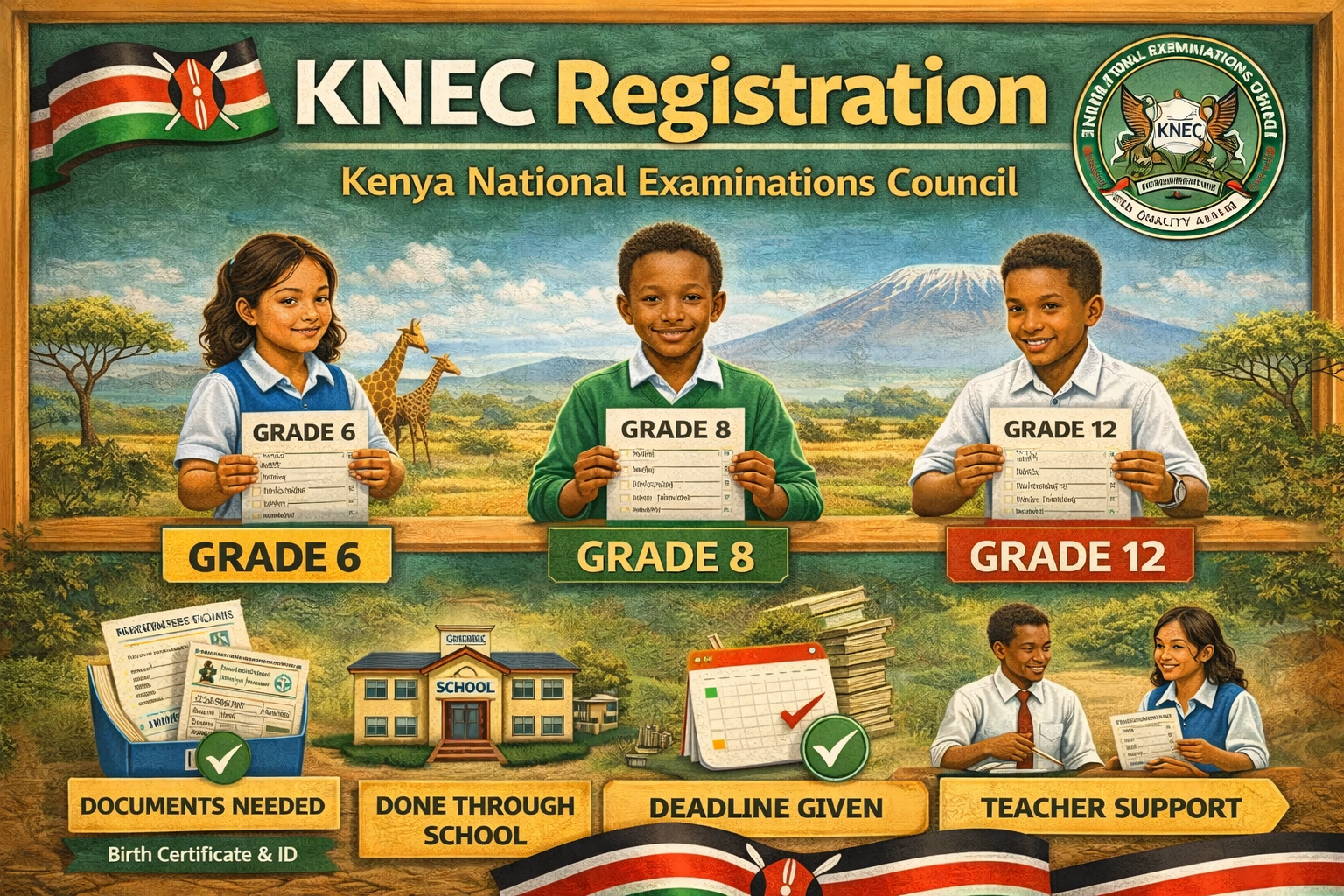
KNEC registration is a mandatory process that every student must complete before sitting for national examinations in Kenya. Whether you’re preparing for KCSE, KCPE, or technical and vocational examinations, understanding how to navigate the KNEC exam registration process is essential for ensuring your candidacy is properly documented and accepted. This comprehensive guide explains everything you need to know about registering for KNEC examinations, including how to access the KNEC portal login, important information about the KNEC registration deadline, detailed breakdown of KNEC fees, required documents, common registration challenges, and step-by-step instructions for both school-based and private candidates. Whether you’re a Form Four student, Standard Eight pupil, private candidate, or parent helping your child through the registration process, this article provides accurate, up-to-date information to help you complete your KNEC registration successfully and on time.
Understanding KNEC Registration in Kenya
The Kenya National Examinations Council manages the registration of all candidates sitting for national examinations across the country. This systematic process ensures every candidate is properly documented, authenticated, and eligible to sit for their respective examinations.
What is KNEC Registration?
KNEC registration is the official process of enrolling candidates into the national examination database before they can sit for any KNEC-administered examination. This process captures essential candidate information including personal details, subject combinations, special needs requirements, and biometric data where applicable.
Registration establishes your official candidacy and generates your unique examination index number, which identifies you throughout the examination process and when results are released. Without proper registration, you cannot sit for national examinations regardless of your academic preparation.
Who Needs to Register with KNEC?
Several categories of learners must complete KNEC registration:
Form Four Students preparing to sit for the Kenya Certificate of Secondary Education (KCSE) examination must register through their schools. This applies to all final-year secondary school students in both public and private institutions.
Standard Eight Pupils sitting for the Kenya Certificate of Primary Education (KCPE) under the 8-4-4 system must be registered by their primary schools. Under CBC, Grade Six learners sitting for the national assessment also undergo KNEC registration.
Private Candidates who are retaking examinations to improve their grades or adults sitting for KNEC examinations independently must complete registration as private candidates following a different process from school candidates.
Technical and Vocational Students enrolled in polytechnics, technical training institutes, and vocational centers sitting for KNEC technical examinations must register through their respective institutions.
Types of KNEC Examinations Requiring Registration
KNEC administers various examinations throughout the year, each requiring separate registration. These include KCSE for Form Four students, KCPE for Standard Eight pupils, Grade Six Assessment under CBC, Business and Technical Examinations for polytechnic and vocational students, Teacher Training Examinations for education colleges, and various professional certification examinations in different technical fields.
Each examination type has specific registration requirements, timelines, and fee structures that candidates must follow.
KNEC Registration Process for School Candidates
Most candidates register for KNEC examinations through their schools, which manage the process on behalf of students.

School-Based Registration Timeline
Schools begin the KNEC exam registration process several months before the actual examination period. For KCSE, registration typically starts in May or June for examinations scheduled in October and November. KCPE registration usually begins around June or July for examinations in October or November.
The registration process follows a structured timeline: initial candidate data collection by schools, verification of candidate information and documents, entry of candidate details into the KNEC system, payment of examination fees, final confirmation and generation of index numbers, and issuance of registration confirmation to candidates.
Step-by-Step School Registration Process
Step 1: Data Collection at School
Your school administration will request specific information and documents from you. This typically includes your full legal names exactly as they appear on your birth certificate or national identification card, date of birth with supporting documentation, parent or guardian contact information, subject combinations you will be examined in, passport-size photographs meeting KNEC specifications, and any special needs requirements that may need examination accommodation.
Provide accurate information as any discrepancies can cause serious problems during examinations or when results are released.

Step 2: Document Verification
Schools verify all documents submitted by candidates against original certificates. The most critical document is your birth certificate, which must match the names you provide for registration. Any differences between your birth certificate and the names you use in school must be reconciled before registration proceeds.
If you have legally changed your name through deed poll or court order, provide the relevant legal documentation to support the change.
Step 3: Fee Payment
Once your details are verified, you must pay the required KNEC fees through your school. Schools collect examination fees from all candidates and remit them to KNEC in bulk. The school will provide you with a receipt confirming your payment.
Ensure you pay fees within the deadline set by your school, as late payment may result in incomplete registration.
Step 4: Registration Confirmation
After completing registration and fee payment, schools provide candidates with confirmation documents showing your registration is complete. This includes your examination index number, which is your unique identifier throughout the examination process.
Keep your index number safe and memorize it, as you will need it to check results and for all future references to your examination.
Step 5: Final Verification
Before examinations begin, schools conduct final verification where candidates confirm their registered details are correct. This is your last opportunity to identify and correct any errors in your registration information.
Subject Registration for KCSE
KCSE candidates must register for specific subject combinations based on what they have studied throughout their secondary education. The standard KCSE examination comprises compulsory subjects that every candidate must sit for (English, Kiswahili, Mathematics), sciences (Biology, Physics, Chemistry, or combinations thereof), humanities and social sciences (History, Geography, Religious Education, Business Studies), and elective subjects based on your school’s curriculum and your chosen streams.
You must register for a minimum number of subjects as specified by KNEC regulations. Carefully review your subject combination during registration to ensure all subjects you’ve studied are captured correctly.
KNEC Portal Login and Online Registration
KNEC has increasingly digitized the registration process through an online portal that schools and private candidates use to register candidates.
Accessing the KNEC Portal
The KNEC portal is accessed through the official KNEC website at www.knec.ac.ke. Schools and registered institutions have specific login credentials that allow them to access the candidate registration section of the portal.
Individual candidates do not typically access the portal directly for school-based registration, as schools handle this process. However, private candidates may need to access specific sections of the portal for their registration.
How Schools Use the KNEC Portal Login
School administrators and designated registration officers receive login credentials from KNEC at the beginning of each registration period. These credentials include a unique school code, username, and password that authenticate the institution.
Once logged in, schools can enter candidate information in bulk, upload candidate photographs, verify entered data, submit registration to KNEC for approval, make corrections if needed before the deadline, download registration confirmation reports, and access candidates’ index numbers once generated.
The portal provides a systematic interface that guides schools through each step of the registration process with clear instructions and validation checks to minimize errors.
Portal Security and Data Protection
The KNEC portal employs security measures to protect candidate information including encrypted connections, secure authentication, regular system backups, and access controls limiting who can view or modify candidate data.
Schools must maintain confidentiality of their portal login credentials and should not share them with unauthorized persons to protect candidate information from misuse.
KNEC Registration for Private Candidates
Private candidates who are not currently enrolled in school must follow a different registration process managed directly through KNEC or designated registration centers.
Who Qualifies as a Private Candidate?
You may register as a private candidate if you previously sat for KCSE but wish to retake the examination to improve your grades, you completed Form Four but were unable to sit for examinations due to specific circumstances, you are an adult learner who studied independently and wishes to obtain KCSE certification, or you were a school candidate whose results were cancelled and you wish to retake examinations.
Private candidates cannot register for their first attempt at KCSE; initial registration must be through a recognized school.
Private Candidate Registration Process
Private candidates follow a more individualized registration process:
Step 1: Visit KNEC Offices or Designated Centers
Private candidate registration typically occurs at KNEC headquarters in Nairobi or designated county registration centers. KNEC announces the specific locations and dates for private candidate registration when the registration period opens.
Step 2: Document Submission
Bring all required documents including your original birth certificate or national ID, previous KCSE result slip if you are retaking examinations, passport-size photographs meeting KNEC specifications, completed registration forms obtained from KNEC, and proof of examination fee payment.
KNEC officials will verify your documents and eligibility for private candidate registration.
Step 3: Fee Payment
Private candidates pay KNEC fees directly through specified payment channels such as bank deposits or mobile money platforms. KNEC provides specific account details and reference numbers for payment tracking.
Private candidate fees are typically higher than school candidate fees, reflecting the additional administrative work involved in individual registration.
Step 4: Biometric Capture
Private candidates undergo biometric registration including fingerprint capture and photograph taken at the registration center. This enhances security and helps prevent examination malpractice.
Step 5: Index Number Issuance
After completing registration and verification, you receive your examination index number and registration confirmation. Keep these documents safe as you will need them to access your examination center details and later to check your results.
Private Candidate Subject Selection
Private candidates can register for specific subjects they wish to retake rather than all subjects. This allows you to focus on improving grades in particular areas. However, you must meet minimum subject requirements as specified by KNEC regulations.
Some subjects may have limited availability for private candidates depending on practical examination requirements and resource availability at examination centers.
KNEC Registration Deadline and Important Dates
Meeting the KNEC registration deadline is absolutely critical, as late registration typically incurs penalties or may not be accepted at all.
Standard Registration Periods
KNEC announces official registration deadlines each year through circulars to schools and public notices. While exact dates vary annually, the general timeline follows a consistent pattern.
For KCSE, the registration deadline usually falls between June and July for examinations scheduled in October and November. Schools receive specific deadline dates and must complete all candidate registration before this cutoff.
For KCPE, registration deadlines typically occur around the same period, with schools required to submit all Standard Eight candidate information within the specified timeframe.
Consequences of Missing Registration Deadlines
If schools fail to register candidates before the deadline, serious consequences may occur including candidates being unable to sit for examinations that year, schools facing penalties from KNEC, additional costs for late registration if permitted, and delayed issuance of index numbers causing examination logistics problems.
Students whose schools miss registration deadlines may need to wait an entire year before they can attempt their examinations, significantly disrupting their educational progression.
Late Registration Provisions
In exceptional circumstances, KNEC may allow late registration with penalties. This typically requires the school principal to submit a formal written appeal explaining the circumstances that caused the delay, provide supporting documentation justifying the late registration, and pay additional late registration fees as determined by KNEC.
Late registration is not guaranteed and is evaluated on a case-by-case basis. Schools and candidates should never rely on late registration provisions but should instead ensure timely completion of the standard registration process.
Monitoring Registration Progress
Schools should provide regular updates to students and parents about registration progress. Students have the right to know when their registration has been submitted, when fees have been paid to KNEC, and when their index numbers have been generated.
If you are concerned about your registration status, communicate with your school administration well before the deadline to ensure any issues are resolved promptly.
KNEC Fees: Costs and Payment Information
Understanding KNEC fees helps students and parents plan financially for examination registration.
KNEC Fee Structure
KNEC charges examination fees that cover the cost of examination administration including question paper production and distribution, examination center logistics, invigilation and supervision, marking and grading, results processing and certification, and administrative overheads.
Fee amounts are set by KNEC and approved by the relevant government authorities. They are subject to periodic review and adjustment.
KCSE Examination Fees
The KNEC fees for KCSE vary depending on the number of subjects registered. As of recent years, the base examination fee for school candidates has been approximately Ksh 3,000 to Ksh 4,000, though this amount changes periodically based on KNEC policy and government directives.
This base fee typically covers registration for standard subjects. Certain specialized subjects or practical examinations may incur additional costs.
KCPE and Grade Six Assessment Fees
KCPE examination fees for Standard Eight pupils are generally lower than KCSE fees, typically ranging around Ksh 1,500 to Ksh 2,000 for school candidates. Grade Six assessment fees under CBC follow a similar structure.
These fees are paid through schools during the registration period and are included in school fee structures or collected as separate examination levies.
Private Candidate Fees
Private candidates pay higher examination fees than school candidates. The fee structure for private candidates includes the base examination fee plus an administrative surcharge for individual processing.
Private candidate fees can range from approximately Ksh 8,000 to Ksh 12,000 or more depending on the number of subjects and examination type. Specific fees are communicated when KNEC announces private candidate registration periods.
Additional Costs
Beyond the base KNEC fees, candidates may incur additional costs including passport photograph fees, document certification costs if required, transport to registration centers for private candidates, late registration penalties if applicable, and fees for special needs accommodation if specialized examination materials are needed.
Payment Methods
School candidates pay KNEC fees through their schools using methods specified by the institution such as bank deposits to the school account, mobile money transfers to school numbers, or cash payments to the school bursar with proper receipting.
Private candidates pay directly to KNEC through specified banking channels, mobile money platforms designated by KNEC, or direct payment at KNEC offices with proper receipting.
Always obtain and keep official receipts for all examination fee payments as proof of payment.
Fee Assistance and Waivers
In some cases, financial assistance may be available for examination fees. The government occasionally provides subsidies for examination fees, particularly for candidates from economically disadvantaged backgrounds. Schools may have bursary programs that help students cover examination costs, and some county governments offer examination fee support to residents.
Students facing genuine financial hardship should discuss their situation with school administrators and explore available assistance programs rather than missing registration due to inability to pay fees.
Required Documents for KNEC Registration
Proper documentation is essential for successful KNEC registration. Missing or incorrect documents can delay or prevent registration.
Essential Documents for School Candidates
Every school candidate must provide an original birth certificate or national identification card showing legal names and date of birth, recent passport-size photographs with specific requirements (white background, clear facial features, formal appearance), and documentation of any name changes if applicable (deed poll, court order).
For candidates with special needs requiring examination accommodations, medical reports or assessment documents from qualified professionals supporting the accommodation request must be provided.
Document Requirements for Private Candidates
Private candidates must submit the same basic documents as school candidates plus previous examination certificates or result slips if retaking examinations, proof of identity (national ID is mandatory for adults), completed application forms obtained from KNEC, and proof of fee payment through designated channels.
Photograph Specifications
KNEC has specific requirements for candidate photographs that must be followed strictly. Photographs must be recent (taken within the last three months), passport size (typically 35mm x 45mm), taken against a plain white or light-colored background, showing clear facial features without obstruction, and formal in nature (no hats, sunglasses, or casual attire unless for religious reasons).
Many registrations are delayed or rejected due to photographs not meeting these specifications. Use professional photo services familiar with KNEC requirements to ensure compliance.
Verification of Documents
All documents submitted undergo verification by schools or KNEC officials. Original documents must be presented for verification even though photocopies may be submitted as part of the registration package.
Any discrepancies between documents and registration information must be resolved before registration is finalized. This might involve obtaining official corrections to certificates or providing additional supporting documentation.
Common KNEC Registration Challenges and Solutions
Name Discrepancies
One of the most common registration problems involves differences between names on birth certificates and names used in school records. This might occur due to spelling variations, inclusion or exclusion of middle names, name changes after birth registration, or errors in school records.
Solution: Reconcile name differences before registration begins. If your birth certificate name differs from your school records, work with school administration to align documents. If you have legally changed your name, provide the legal documentation. In some cases, you may need to apply for a birth certificate correction through the civil registration office.
Missing or Lost Documents
Students sometimes discover their birth certificates are missing when registration begins. Obtaining replacement documents takes time and may cause registration delays.
Solution: Locate and secure your birth certificate well before registration period. If lost, apply for a replacement birth certificate from the Civil Registration Department immediately. Keep photocopies of important documents as backups.
Late Fee Payment
Financial constraints may cause students to delay paying examination fees, risking missed registration deadlines.
Solution: Plan for examination fees early by discussing costs with parents at the beginning of the academic year, applying for available bursaries or financial assistance programs, and arranging payment plans with school administration if full payment at once is difficult.
Schools should communicate fee requirements and deadlines clearly to give families adequate time to prepare.
Technical Portal Issues
Schools occasionally experience technical difficulties with the KNEC portal login or during the registration process including login credential problems, system connectivity issues, data upload errors, or portal downtime during peak usage.
Solution: Schools should register candidates progressively rather than waiting until the deadline to avoid last-minute technical problems. If portal issues occur, contact KNEC technical support immediately for assistance. Keep offline backups of candidate data in case resubmission is needed.
Special Needs Accommodation
Candidates with disabilities or special needs may face challenges ensuring appropriate examination accommodations are registered.
Solution: Inform school administration about special needs early in the registration process. Provide proper medical documentation supporting accommodation requests. Work with KNEC disability support services to ensure appropriate arrangements are made.
Verifying Your KNEC Registration Status
After registration is submitted, verifying that your information is correctly captured is important.
Confirming Registration with Your School
Schools should provide each candidate with registration confirmation showing your full names as registered, date of birth, subject combination, index number once generated, and confirmation of fee payment.
Review this information carefully and immediately report any errors to school administration. Some errors can be corrected if identified before final submission deadline, but after the deadline, corrections become difficult or impossible.
Index Number Assignment
Your examination index number is assigned after successful registration. This unique identifier follows a specific format that includes your school code, year of examination, and candidate number.
Verify your index number is correct and memorize it, as you will use it throughout the examination period and when checking results.
Pre-Examination Verification
Before examinations begin, KNEC may conduct verification exercises where candidates confirm their identity and registration details. This may involve biometric verification, photograph confirmation, and signature verification.
Participate in all verification activities promptly to avoid examination day complications.
Frequently Asked Questions (FAQs)
What is KNEC registration and when should I register?
KNEC registration is the official process of enrolling candidates into the national examination database before they sit for KCSE, KCPE, or other KNEC examinations. School candidates register through their schools between May and July for examinations scheduled later that year. The exact KNEC registration deadline is announced annually by KNEC through official circulars to schools. Private candidates register during specific periods announced by KNEC, typically a few months before examinations. Registration must be completed before the deadline as late registration may not be accepted or may incur penalties.
How do I access the KNEC portal login?
The KNEC portal is accessed through the official KNEC website at www.knec.ac.ke. School administrators and designated registration officers receive unique login credentials including school codes, usernames, and passwords from KNEC at the beginning of each registration period. Individual school candidates do not typically access the portal directly, as schools handle registration on their behalf. Private candidates may access specific portal sections using credentials provided during their registration process at KNEC offices or designated centers.
How much are KNEC fees for examinations?
KNEC fees vary depending on examination type and candidate category. For KCSE school candidates, fees typically range from Ksh 3,000 to Ksh 4,000, while KCPE fees are generally around Ksh 1,500 to Ksh 2,000. Private candidates pay higher fees, approximately Ksh 8,000 to Ksh 12,000 or more, depending on the number of subjects. These fees are subject to periodic review by KNEC and government authorities. Additional costs may include photographs, document certification, and late registration penalties if applicable. Always confirm current fee amounts with your school or KNEC offices as they may change.
What happens if I miss the KNEC registration deadline?
Missing the KNEC registration deadline has serious consequences including being unable to sit for examinations that year, potentially delaying your educational progression by an entire year. In exceptional circumstances, KNEC may allow late registration with substantial penalties, but this requires written appeals from school principals explaining the delay, supporting documentation, and payment of additional late fees. Late registration is not guaranteed and is evaluated case-by-case. Students should ensure their schools register them well before the deadline and should verify their registration status to avoid last-minute problems.
What documents do I need for KNEC exam registration?
For KNEC registration, you must provide your original birth certificate or national identification card showing your legal names and date of birth, recent passport-size photographs meeting KNEC specifications (white background, clear facial features), documentation of any legal name changes if applicable, and for candidates with special needs, medical reports supporting accommodation requests. Private candidates additionally need previous examination certificates if retaking exams, completed application forms from KNEC, and proof of fee payment. All documents are verified against originals, so ensure your documents are accurate and available early in the registration period.
Can I change my registered subjects after submitting my KNEC registration?
Subject changes after registration submission are extremely difficult and may not be permitted, especially after the registration deadline passes. If you need to change subjects, inform your school administration immediately while the registration portal is still open. Schools may be able to modify subject combinations before final submission to KNEC if requested early enough. Once the deadline passes and index numbers are generated, subject changes typically cannot be made. This is why carefully reviewing your subject combination during initial registration is critical to ensure all intended subjects are correctly captured.
Conclusion
KNEC registration is a critical process that every examination candidate must complete successfully to participate in national examinations. Understanding the registration process, accessing the KNEC portal login through your school or as a private candidate, meeting the KNEC registration deadline, and ensuring proper payment of KNEC fees are all essential steps in your examination journey. Whether you are a school candidate relying on your institution to manage registration or a private candidate handling the process independently, being well-informed about requirements, deadlines, and procedures helps ensure smooth registration without complications.
Start preparing for registration early by gathering required documents, ensuring your school records match your birth certificate, planning financially for examination fees, and staying informed about official registration timelines announced by KNEC. Communicate proactively with your school administration or KNEC offices if you have questions or concerns, and verify your registration details carefully once the process is complete. Successful KNEC registration sets the foundation for your examination experience, so approach it with the seriousness and attention to detail it deserves. Your investment in proper registration today ensures you can focus on examination preparation and performance when the time comes.