Understanding how CBC exams are marked in Kenya is essential for every parent, teacher, and learner navigating the Competency-Based Curriculum. Unlike the traditional 8-4-4 system that relied heavily on national examinations, CBC uses a comprehensive assessment approach that evaluates learners continuously throughout their educational journey. This guide explains the CBC marking scheme, how scores are calculated, what CBC learner assessment involves, and how CBE grading works in Kenyan schools. Whether you’re a parent trying to understand your child’s report form, a teacher implementing CBC assessments, or a learner wanting to know how your performance is evaluated, this article provides clear, accurate information based on Kenya’s current education framework.
Understanding CBC Assessment in Kenya
The Competency-Based Curriculum represents a fundamental shift from the examination-focused 8-4-4 system to a holistic approach that assesses learners’ knowledge, skills, values, and abilities throughout their learning journey.
What Makes CBC Assessment Different
CBC assessment focuses on what learners can do with the knowledge they acquire rather than just what they know. This approach evaluates competencies across multiple domains including cognitive abilities (thinking and reasoning), psychomotor skills (practical abilities), and affective development (values, attitudes, and social skills).
Under CBC, assessment happens continuously rather than only at the end of a learning period. Teachers observe, record, and evaluate learner progress daily, weekly, and termly through various methods including projects, practical activities, oral presentations, written tests, and peer assessments.
The Role of Formative and Summative Assessment
CBC employs two main types of assessment that work together to provide a complete picture of learner development.
Formative Assessment occurs during the learning process and helps teachers understand how well learners are grasping concepts. This ongoing assessment includes daily observations, class activities, homework assignments, group discussions, and informal quizzes. The primary purpose is to identify learning gaps early and adjust teaching methods to support every learner effectively.
Summative Assessment happens at the end of a learning period such as end of term, end of year, or end of a learning level. These assessments evaluate overall achievement and competency development. For CBC, summative assessments include end-of-term examinations, end-of-year assessments, and culminate in the Grade 6 national assessment for primary level learners.
The CBC Marking Scheme Explained
The CBC marking scheme differs significantly from the percentage-based grading system many Kenyan parents knew from the 8-4-4 curriculum.
Competency-Based Scoring
CBC uses a five-level proficiency scale that describes what learners can demonstrate at each level. This rubric-based approach provides more meaningful feedback than simple numerical scores.
The five proficiency levels are:
Exceeding Expectations (EE): The learner demonstrates exceptional understanding and can apply concepts in new and creative ways. They consistently perform beyond the required competency standards and often help peers understand concepts.
Meeting Expectations (ME): The learner demonstrates solid understanding and can apply concepts correctly in familiar contexts. They consistently achieve the required competency standards independently.
Approaching Expectations (AE): The learner demonstrates partial understanding and can apply concepts with some support. They are developing toward the required competency standards but need additional practice and guidance.
Below Expectations (BE): The learner demonstrates limited understanding and requires significant support to apply concepts. They are working toward the required competency standards but need substantial intervention.
Not Yet Meeting Expectations (NYM): This level is rarely used and indicates a learner who has not yet demonstrated basic understanding even with support. It signals the need for comprehensive intervention strategies.
Subject-Specific Assessment
Different learning areas use assessment approaches suited to their nature. For literacy subjects like English and Kiswahili, assessment focuses on reading comprehension, writing skills, speaking ability, and listening comprehension. Teachers use rubrics that evaluate creativity, accuracy, fluency, and expression.
Mathematics assessment evaluates problem-solving abilities, numerical operations, logical reasoning, and practical application of mathematical concepts in real-life situations. Science subjects assess scientific thinking, practical skills, observation abilities, and understanding of scientific concepts.
Creative subjects including Art, Music, Physical Education, and Home Science emphasize practical demonstration of skills. Assessment in these areas often involves performance tasks, creative projects, and practical exhibitions.
How CBC Score Calculation Works
CBC score calculation considers multiple components to provide a comprehensive evaluation of learner achievement.
Continuous Assessment Marks (CAM)
Throughout each term, teachers collect marks from various assessment activities. These typically include classwork assignments completed during lessons, homework assignments given for practice, topic tests administered after completing specific topics, practical activities and projects, and oral presentations or discussions.
The marks from these various activities are recorded and contribute to the overall termly assessment. Most schools allocate specific percentages to different assessment components. For example, continuous assessments might contribute 40 percent while the end-of-term examination contributes 60 percent, though these ratios can vary by school.
End-of-Term Examination Scores
At the end of each term, learners sit for formal examinations covering the content taught during that term. These examinations are structured to test different competency levels from basic recall to higher-order thinking skills like analysis, evaluation, and creation.
The examination questions typically include objective items (multiple choice, true/false, matching), short answer questions requiring brief responses, and extended response questions requiring detailed explanations or problem-solving.
Combining Scores for Overall Assessment
Teachers combine continuous assessment marks with examination scores using a predetermined formula. A common approach is calculating the average of all continuous assessment activities, then combining this with the examination score according to the school’s assessment policy.
For example, if continuous assessment contributes 40 percent and examinations contribute 60 percent, a learner scoring 75 percent in continuous assessment and 80 percent in examinations would have an overall score calculated as follows: (0.40 × 75) + (0.60 × 80) = 30 + 48 = 78 percent.
This overall percentage is then converted to the CBC proficiency scale based on established grade boundaries set by the school or national guidelines.
Understanding CBE Grading in Kenya
Competency-Based Education (CBE) grading goes beyond numerical scores to provide descriptive feedback about learner competencies.
Grade Boundaries and Proficiency Levels
While specific grade boundaries may vary slightly between schools, the Ministry of Education provides general guidelines for converting percentage scores to proficiency levels:
Exceeding Expectations typically corresponds to scores above 80 percent, indicating mastery and ability to extend learning independently. Meeting Expectations usually ranges from 60 to 80 percent, showing solid achievement of required competencies. Approaching Expectations generally falls between 40 and 59 percent, indicating developing competency that needs reinforcement. Below Expectations ranges from 20 to 39 percent, signaling need for intervention. Not Yet Meeting Expectations represents scores below 20 percent, requiring immediate comprehensive support.
Reporting Learner Progress
CBC report forms provide much richer information than traditional report cards. Instead of just showing numerical scores, CBC reports include proficiency levels for each learning area, specific competencies achieved by the learner, areas requiring improvement with targeted recommendations, teacher comments describing learning behaviors and attitudes, and suggestions for parental support at home.
This comprehensive reporting helps parents understand not just how well their child performed but specifically what skills they have developed and where they need additional support.
Tracking Progress Over Time
Since CBC emphasizes growth and development, tracking learner progress across terms and grades becomes crucial. Teachers maintain detailed records showing how learners move between proficiency levels over time. A learner who is Approaching Expectations in Term 1 and moves to Meeting Expectations by Term 3 demonstrates clear progress even if the numerical score increase seems modest.
CBC Learner Assessment Methods Used in Kenyan Schools
Teachers employ diverse assessment methods to capture the full range of learner competencies.
Observation-Based Assessment
Teachers continuously observe learners during lessons, noting participation levels, problem-solving approaches, collaboration skills, creativity in activities, and attitude toward learning. These observations are documented systematically using observation checklists or anecdotal records that capture specific instances of competency demonstration.
Performance Tasks and Projects
Learners complete hands-on tasks that require them to apply knowledge and skills in practical situations. These might include science experiments demonstrating understanding of concepts, art projects showcasing creativity and technique, group presentations requiring research and communication skills, or community service projects developing civic responsibility.
Performance tasks are assessed using detailed rubrics that specify criteria for each proficiency level, ensuring consistency and fairness in evaluation.
Portfolios
Some schools implement portfolio assessment where learners compile their best work samples over time. Portfolios might include written assignments, artwork, problem-solving demonstrations, self-reflections on learning, and peer feedback examples. Portfolios provide tangible evidence of growth and allow learners to take ownership of their learning journey.
Self and Peer Assessment
CBC encourages learners to develop metacognitive skills through self-assessment and peer evaluation. Learners reflect on their own performance against rubric criteria, identify their strengths and areas for improvement, set personal learning goals, and provide constructive feedback to classmates on their work.
This develops critical thinking and helps learners become active participants in their own learning rather than passive recipients of grades.
The Role of National Assessments
While CBC emphasizes continuous assessment, national evaluations still play a role in the education system.
Grade 6 National Assessment
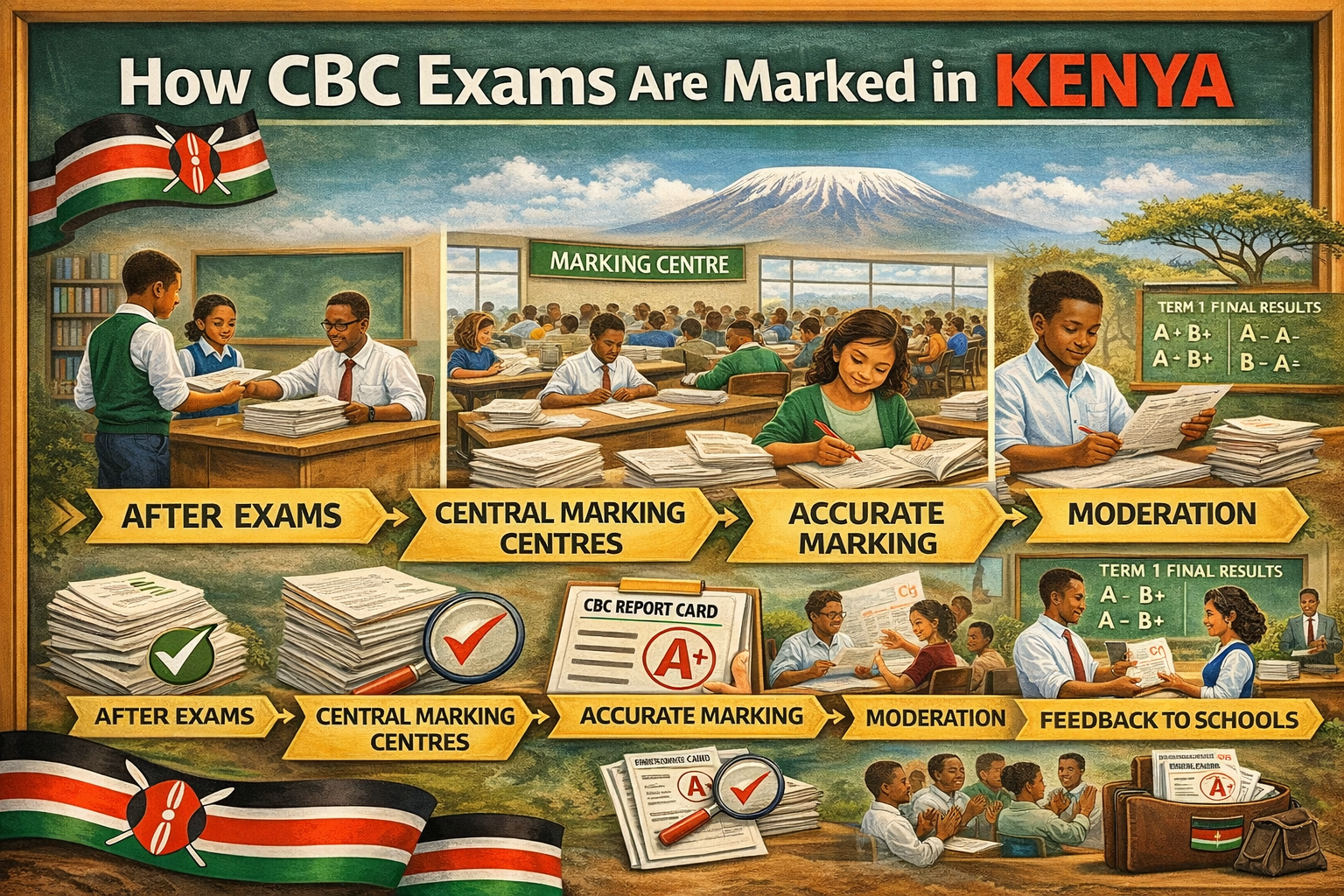
The Grade 6 assessment, administered by KNEC, represents the summative evaluation at the end of primary education under CBC. This assessment evaluates competencies developed across all learning areas throughout the primary cycle.
Unlike KCPE which was purely examination-based, the Grade 6 assessment considers both the national examination component and the school-based assessment records accumulated throughout the learner’s primary education. Schools submit comprehensive learner profiles alongside examination results to provide a holistic picture of each learner’s abilities.
Moderation and Standardization
To ensure consistency in marking across different schools, the Ministry of Education conducts moderation exercises where teachers from various schools come together to compare and standardize their assessment practices. This helps maintain fairness and ensures that a learner assessed in one school would receive comparable evaluation in another school using the same standards.
Common Challenges in CBC Marking and Assessment
Teacher Workload and Record Keeping
The comprehensive nature of CBC assessment requires teachers to maintain extensive records for every learner across multiple assessment areas. This significantly increases teacher workload compared to the 8-4-4 system where assessment mainly involved marking periodic examinations.
Many teachers struggle with balancing teaching responsibilities with the documentation requirements of CBC assessment. Schools address this through training on efficient record-keeping systems, providing assessment templates and tools, allocating time specifically for assessment activities, and using technology where available to streamline record management.
Subjectivity in Grading
Competency-based assessment involves more subjective judgment than purely numerical marking. Two teachers might assess the same learner’s work differently based on their interpretation of rubric criteria.
Schools minimize this challenge through collaborative moderation sessions where teachers discuss and agree on standards, using detailed rubrics with specific descriptors for each level, regular professional development on assessment best practices, and peer review of assessment decisions for consistency.
Parental Understanding
Many Kenyan parents educated under 8-4-4 find CBC grading confusing. They struggle to understand what proficiency levels mean compared to the familiar percentage scores and class positions they experienced.
Effective communication between schools and parents is crucial. Schools should hold regular parent meetings explaining CBC assessment, provide clear explanations on report forms, offer examples showing what each proficiency level means in practice, and guide parents on how to support learning at home based on assessment results.
Resource Constraints
Implementing comprehensive CBC assessment requires adequate resources including assessment materials and tools, training for teachers on new assessment methods, time for conducting diverse assessment activities, and technology for record keeping and analysis.
Many Kenyan schools, particularly in rural areas, face resource limitations that affect their ability to implement CBC assessment fully. Schools work within available resources by prioritizing essential assessment activities, using locally available materials creatively, sharing resources across schools in the same locality, and seeking support from education partners and the government.
Practical Tips for Parents Supporting CBC Learners
Understanding Your Child’s Report
When you receive your child’s CBC report form, focus on the proficiency levels rather than comparing with other children. Look for trends across subjects to identify overall strengths and challenges. Read teacher comments carefully as they provide specific insights into your child’s learning behaviors. Note the competencies achieved and those still developing to guide your support at home.
Supporting Learning Based on Assessment Results
If your child is Exceeding Expectations in certain areas, provide opportunities for extension such as advanced reading materials, creative projects, or mentorship in those areas. For areas where they are Meeting Expectations, maintain consistent support and encouragement to sustain performance.
When your child is Approaching Expectations or Below Expectations in any area, work closely with teachers to understand specific gaps, create structured practice opportunities at home, seek additional learning resources or tutoring if necessary, and maintain positive encouragement to build confidence rather than creating pressure.
Asking the Right Questions
Engage constructively with teachers by asking what specific skills my child has mastered, which areas need more practice and how I can help at home, whether my child participates actively in class, how my child collaborates with peers, and what learning materials or activities you recommend for home support.
Avoid comparing your child’s performance with classmates as CBC focuses on individual growth rather than competition. Instead, track your own child’s progress over time.
Practical Tips for Teachers Implementing CBC Assessment
Efficient Record Keeping
Develop systematic approaches to documentation using assessment trackers organized by learning area, maintaining digital records where possible to reduce paperwork, using coding systems for quick entry of observations, and setting aside dedicated time each week for updating assessment records.
Designing Quality Assessment Tasks
Create assessment activities that genuinely measure competencies rather than just recall by including real-world application scenarios, allowing multiple ways for learners to demonstrate understanding, using open-ended questions requiring critical thinking, and incorporating practical demonstrations alongside written work.
Providing Meaningful Feedback
Move beyond simply marking right or wrong by giving specific feedback on what the learner did well, explaining clearly what needs improvement and how, involving learners in assessment through self-reflection, and using feedback to adjust teaching approaches for better learning outcomes.
Collaborating with Colleagues
Work with fellow teachers through regular moderation meetings to ensure consistent standards, sharing effective assessment strategies and tools, co-creating assessment rubrics for similar learning areas, and peer observation to learn from each other’s practices.
Frequently Asked Questions (FAQs)
How are CBC exams marked differently from 8-4-4 exams?
CBC assessment uses a competency-based approach rather than purely percentage scores. While 8-4-4 exams focused mainly on numerical marks and class ranking, CBC marking evaluates learners across five proficiency levels (Exceeding Expectations, Meeting Expectations, Approaching Expectations, Below Expectations, and Not Yet Meeting Expectations). CBC considers continuous assessment throughout the term alongside examinations, and focuses on what learners can demonstrate they know and can do rather than just memorized content.
What is the CBC marking scheme and how does it work?
The CBC marking scheme is a rubric-based system that assesses learner competencies across multiple levels. Teachers use specific criteria to determine whether a learner’s performance exceeds, meets, approaches, or falls below expected standards for their grade level. The scheme combines continuous assessment marks from classwork, homework, projects, and practical activities with end-of-term examination scores. These combined scores are then converted to proficiency levels using established grade boundaries, typically with scores above 80 percent indicating Exceeding Expectations and scores above 60 percent showing Meeting Expectations.
How is CBC score calculation done in Kenyan schools?
CBC score calculation involves combining continuous assessment marks with examination scores according to a predetermined weighting system. Most schools assign a certain percentage to continuous assessment (commonly 40 percent) and another to examinations (commonly 60 percent). Teachers calculate the weighted average of these components to get an overall score, which is then converted to one of the five proficiency levels based on established grade boundaries. This process ensures that both ongoing learning activities and formal examinations contribute to the final assessment.
What does CBE grading mean for my child’s learning?
CBE (Competency-Based Education) grading provides descriptive information about what your child knows and can do rather than just a number or letter grade. It shows specific competencies your child has achieved, identifies areas where they excel and can extend their learning, highlights skills that need more development, and gives targeted guidance on how to support improvement. CBE grading focuses on individual growth and mastery rather than comparison with other learners, helping you understand your child’s learning journey more comprehensively.
How often is CBC learner assessment done?
CBC learner assessment happens continuously throughout the school term. Teachers conduct daily informal observations during lessons, weekly assessment activities like quizzes and assignments, topic tests after completing specific units of study, mid-term assessments in some schools, and end-of-term examinations. Additionally, projects, practical activities, and performance tasks are assessed throughout the term. This continuous approach provides multiple opportunities for learners to demonstrate their competencies and allows teachers to track progress consistently.
Can my child improve their proficiency level during the term?
Absolutely yes. The continuous nature of CBC assessment means learners have ongoing opportunities to improve their proficiency levels. If a child receives Approaching Expectations in mid-term, they can work on identified gaps and potentially achieve Meeting Expectations or even Exceeding Expectations by the end of term. Teachers use formative assessment to identify areas needing improvement and provide targeted support. Parents can help by working with teachers to understand specific areas for development and providing consistent support at home through practice activities and encouragement.
Conclusion
Understanding how CBC exams are marked in Kenya empowers parents, teachers, and learners to engage meaningfully with the new education system. The CBC marking scheme represents a comprehensive approach that values continuous growth, multiple competencies, and holistic development rather than reducing a child’s abilities to a single numerical score. By focusing on what learners can demonstrate through the CBC learner assessment framework, Kenya’s education system aims to develop well-rounded individuals prepared for the demands of modern society.
As the CBC system continues to mature, ongoing communication between teachers and parents, continuous professional development for educators, and consistent support for learners will ensure that assessment serves its true purpose of enhancing learning rather than merely measuring it. Whether your child is Exceeding Expectations or working to meet them, remember that CBC assessment provides a roadmap for growth and development tailored to each learner’s unique journey. Stay engaged with your child’s learning, communicate regularly with teachers, and use assessment information constructively to support continuous improvement and celebration of achievements along the way.