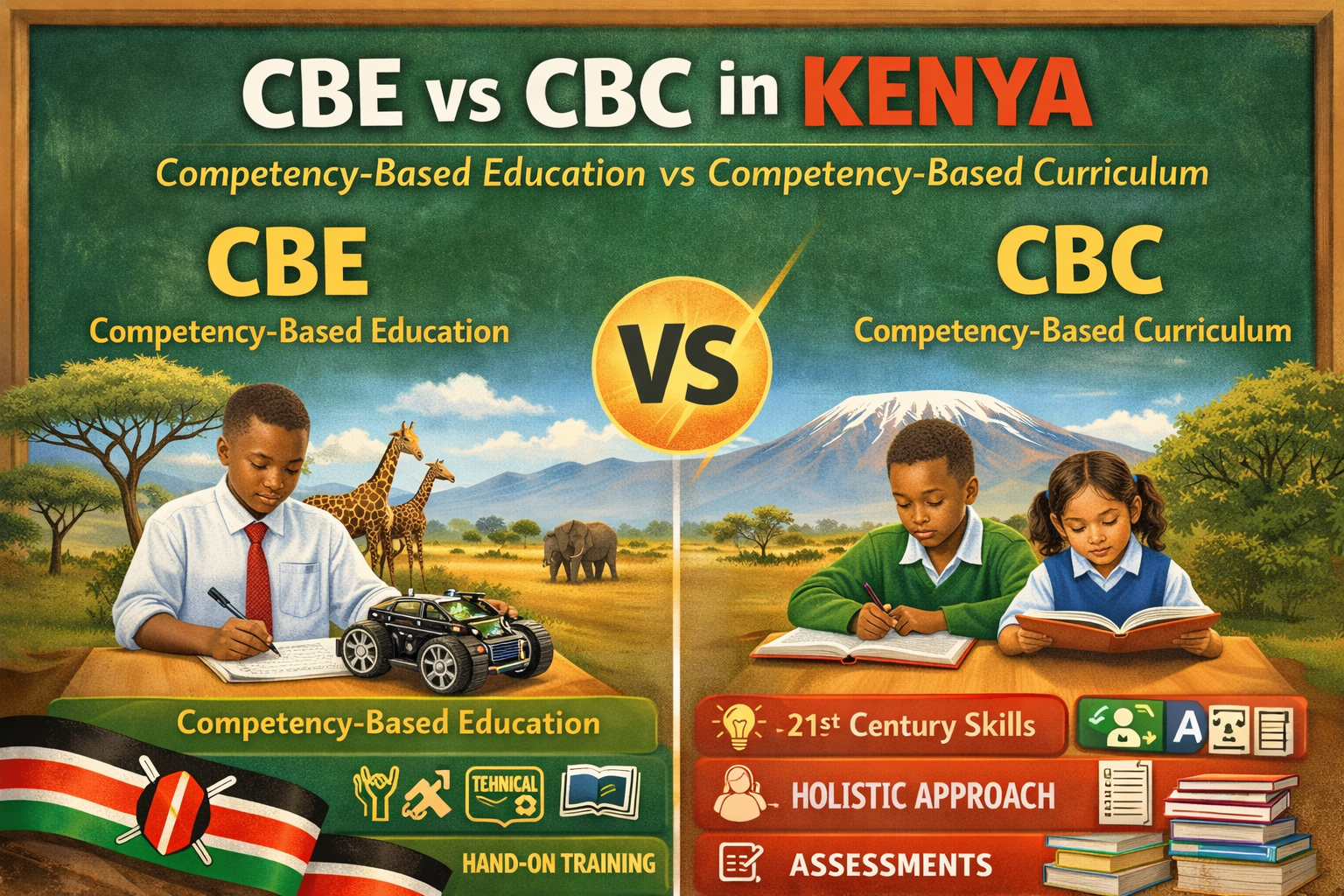
If you’ve heard people talking about both CBC and CBE in Kenya’s education system, you might be confused about whether they’re the same thing or different. Many Kenyan parents, teachers, and even education stakeholders mix up these terms or use them interchangeably. The confusion is understandable, especially since both involve major changes to how children learn in Kenya.
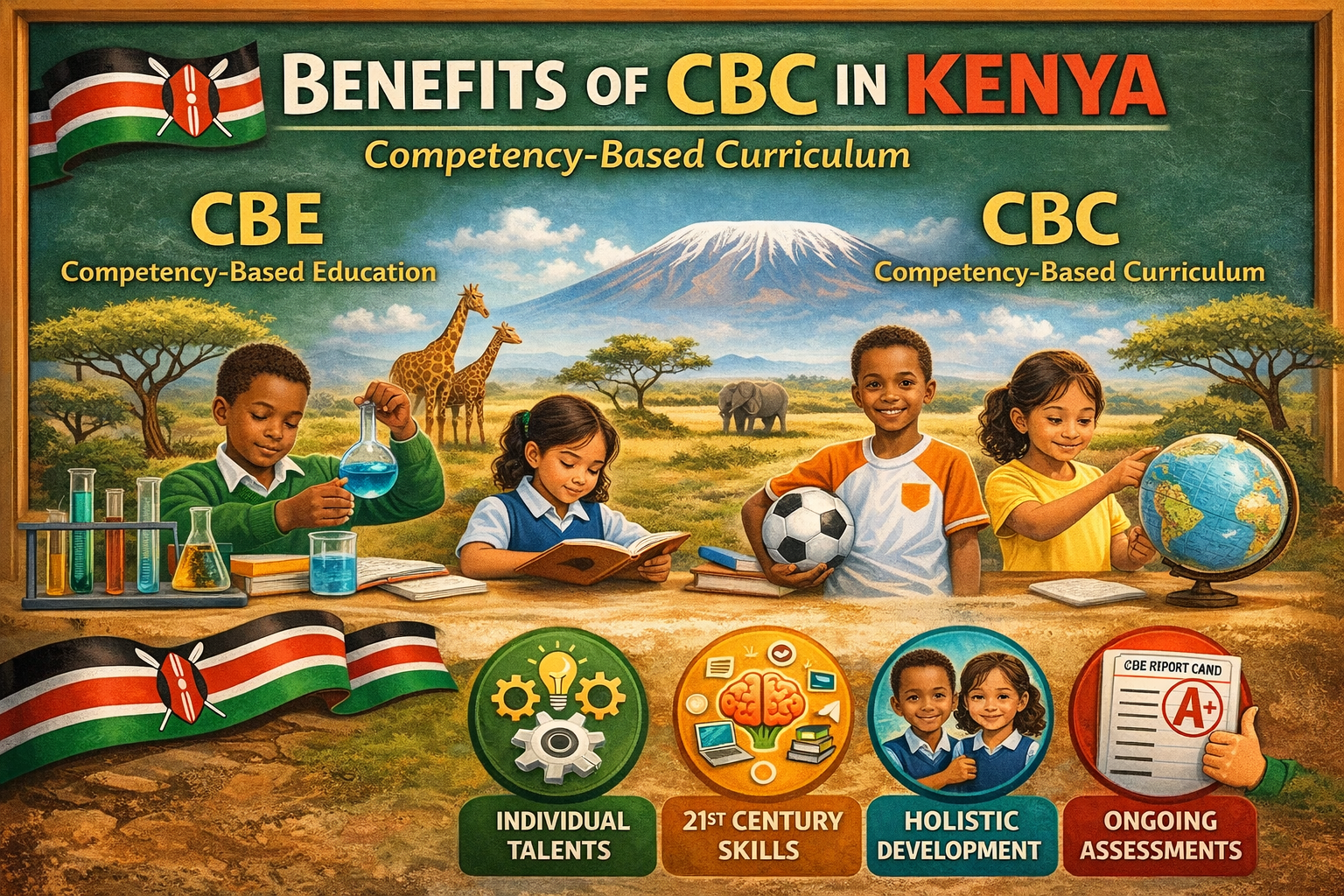
CBE vs CBC in Kenya is actually not about choosing between two competing systems. Rather, understanding the difference between CBE and CBC helps clarify how Kenya’s education transformation works. CBC (Competency-Based Curriculum) refers to the specific curriculum framework and structure—what learners study and when. CBE (Competency-Based Education) describes the broader teaching and learning approach—how education is delivered and assessed.
This article explains the CBE meaning, how it relates to CBC implementation, and what both mean for Kenya’s education system. Whether you’re a parent trying to understand your child’s schooling or a teacher implementing these changes, this guide will clarify how CBC and CBE work together to transform learning in Kenya.
Understanding CBE Meaning
What is Competency-Based Education (CBE)?
Competency-Based Education (CBE) is an educational philosophy and approach that focuses on learners demonstrating mastery of specific skills, knowledge, and attitudes rather than simply completing a set amount of instructional time or passing exams. In CBE, learners progress based on their ability to demonstrate competencies, not just because they’ve spent a certain number of hours in class or reached a particular age.
Core Principles of CBE
CBE around the world, including in Kenya, operates on several key principles:
Mastery-Based Progression Learners move forward only after demonstrating competency in required skills. A child doesn’t move to multiplication until they’ve mastered addition, regardless of how long it takes.
Personalized Learning CBE recognizes that learners develop at different rates. Some children might master reading quickly but need more time for mathematics. The system allows for this individual variation.
Clear Learning Outcomes CBE requires clearly defined, measurable learning outcomes. Teachers, learners, and parents know exactly what skills and knowledge learners need to develop.
Multiple Forms of Assessment Instead of relying solely on written exams, CBE uses various assessment methods including observation, practical demonstrations, projects, and portfolios to measure competency.
Real-World Application CBE emphasizes applying knowledge in practical, real-world contexts rather than just memorizing facts. Learners should be able to use what they learn.
Continuous Feedback Learners receive ongoing feedback throughout their learning journey, helping them improve continuously rather than waiting for end-of-term results.
CBE in the Global Context
Competency-Based Education isn’t unique to Kenya. Many countries have adopted CBE approaches, including parts of the United States, Canada, New Zealand, and several European nations. Each country adapts CBE principles to fit its cultural context and educational goals.
Kenya’s adoption of CBE aligns the country with global best practices while tailoring the approach to meet Kenya’s specific needs, including Vision 2030 goals and the realities of the Kenyan job market.
Understanding CBC in Kenya
What is the Competency-Based Curriculum (CBC)?
The Competency-Based Curriculum (CBC) is Kenya’s specific curriculum framework designed and implemented by the Kenya Institute of Curriculum Development (KICD) and the Ministry of Education. Launched in 2017, CBC is Kenya’s practical implementation of competency-based education principles.
CBC provides the structure, content, and guidelines for what Kenyan learners study from Pre-Primary through Senior Secondary and into tertiary education. It specifies learning areas, assessment methods, and the progression pathway through Kenya’s 2-6-3-3-3 education structure.
Key Features of CBC
Structured Framework CBC follows a 2-6-3-3-3 structure:
- 2 years Pre-Primary
- 6 years Primary (Grades 1-6)
- 3 years Junior Secondary (Grades 7-9)
- 3 years Senior Secondary (Grades 10-12)
- 3 years Tertiary education
Defined Learning Areas CBC specifies what subjects or learning areas children study at each level, from Environmental Activities in lower primary to specialized subjects in senior secondary.
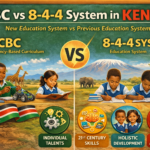
Seven Core Competencies CBC identifies seven key competencies all Kenyan learners should develop: communication and collaboration, critical thinking and problem-solving, creativity and imagination, citizenship, digital literacy, learning to learn, and self-efficacy.
Values Integration CBC emphasizes seven core values: love, responsibility, respect, unity, peace, patriotism, and integrity, integrated throughout learning.
Career Pathways From Grade 7 onwards, CBC guides learners toward career pathways in STEM, Arts and Sports Sciences, Social Sciences, or Technical and Vocational tracks.
The Difference Between CBE and CBC
CBE: The Philosophy
Think of CBE as the “how” and “why” of education. It’s the educational philosophy that says learning should focus on competencies rather than time spent in class or exam scores alone. CBE is:
- A teaching and learning approach
- A way of thinking about education
- An assessment philosophy
- Applied globally in various forms
CBC: The Practical Application
CBC is the “what” and “when” of Kenya’s education. It’s the specific curriculum document that operationalizes CBE principles in Kenyan schools. CBC is:
- A curriculum framework
- Kenya’s specific implementation of CBE
- A structured program with defined content
- Unique to Kenya (though similar to other countries’ competency-based curricula)
The Relationship Between CBE and CBC
CBE and CBC work together—they’re not alternatives or competitors. Here’s how they relate:
CBE provides the foundation The competency-based education philosophy informs how CBC was designed. Kenya adopted CBE principles, then created CBC as the vehicle to deliver those principles.
CBC operationalizes CBE CBC takes abstract CBE principles and makes them concrete. When KICD writes that Grade 3 learners should “demonstrate understanding of place value up to thousands,” that’s CBC translating CBE principles into specific learning outcomes.
Both focus on competencies Whether you call it CBE or CBC, the focus remains on developing demonstrable skills, knowledge, and attitudes rather than just covering content.
Assessment approaches align Both CBE and CBC emphasize continuous assessment, multiple assessment methods, and measuring against defined outcomes rather than ranking learners against each other.
A Simple Analogy
Think of it this way:
- CBE is like saying “We should build houses that are energy-efficient and environmentally friendly” (the philosophy)
- CBC is like the actual architectural plan that shows exactly how to build that house in Kenya with specific materials, dimensions, and features (the implementation)
You need both the philosophy and the plan to succeed.
How CBC Implementation Works in Kenya
The CBC Rollout Timeline
Kenya’s CBC implementation has happened in phases:
2017
- CBC launched with Pre-Primary 1 (PP1) and Grade 1
- Pilot programs in selected schools
- Teacher training began
2018
- Pre-Primary 2 (PP2) and Grade 2 added
- Expanded to all public schools
- Curriculum materials distributed
2019-2023
- Gradual progression through primary grades
- Grade 6 completed in 2023
- Development of Junior Secondary curriculum and infrastructure
2024-2025
- First CBC cohort in Grade 8 (Junior Secondary)
- Senior Secondary curriculum development ongoing
- Infrastructure and teacher deployment challenges addressed
2026 onwards
- Continued rollout through Junior Secondary
- First CBC cohort to enter Senior Secondary in 2027
- First CBC KCSE expected in 2029
Key Implementing Agencies
Kenya Institute of Curriculum Development (KICD) KICD designs the curriculum, develops learning materials, trains teachers on content delivery, and provides ongoing support to schools.
Ministry of Education The Ministry oversees policy implementation, allocates resources, coordinates with county governments, and ensures quality standards across all schools.
Teachers Service Commission (TSC) TSC handles teacher deployment, professional development, and ensures adequate staffing for CBC subjects including new learning areas.
Kenya National Examinations Council (KNEC) KNEC develops assessment frameworks aligned with CBC, creates competency-based examinations, and administers national assessments like KJSEA.
Infrastructure and Resource Requirements
CBC implementation requires significant resources:
Physical Infrastructure
- Classrooms for Junior Secondary (often requiring construction or conversion)
- Science laboratories, computer rooms, and technical workshops
- Libraries and resource centers
- Safe play areas for Pre-Primary learners
Learning Materials
- Textbooks and teacher guides aligned with CBC
- Digital learning devices where possible
- Locally available materials for practical activities
- Assessment tools and portfolio materials
Human Resources
- Teachers trained in CBC methodology
- Adequate teacher-learner ratios
- Support staff for specialized learning areas
- Educational assessment and technology specialists
Challenges in CBC Implementation
Infrastructure Gaps Many schools, especially in rural and marginalized areas, lack adequate facilities for practical CBC learning. Science labs, computer rooms, and workshop spaces remain insufficient.
Teacher Preparedness Not all teachers received adequate CBC training initially. Some still struggle with learner-centered methods, continuous assessment practices, and using rubrics effectively.
Resource Constraints Government budgets don’t always match CBC’s resource requirements. Schools sometimes lack textbooks, teaching aids, or materials for practical activities.
Transition Challenges The first CBC cohorts face uncertainty as systems are still being refined. Questions about junior secondary placement, senior secondary pathways, and university admission create anxiety.
Parent Understanding Many parents don’t fully understand CBC, leading to frustration with homework, confusion about assessment, or resistance to the new system.
Assessment Complexity Implementing truly competency-based assessment requires more time and skill than traditional marking. Some teachers revert to familiar methods under pressure.
Kenya Education System Under CBC
The Complete Education Pathway
The Kenya education system under CBC offers a more flexible and diverse pathway than the old 8-4-4 structure:
Early Years (Ages 4-6) Pre-Primary education emphasizes play-based learning, social skills development, and school readiness. Children learn through games, songs, stories, and hands-on activities.
Primary Education (Ages 6-12) Grades 1-6 provide foundational literacy, numeracy, and general knowledge. Learners explore various learning areas while developing core competencies and values.
Junior Secondary (Ages 12-15) Grades 7-9 introduce more specialized subjects. Learners choose electives based on interests and abilities, beginning to identify potential career pathways. This level ends with the Kenya Junior Secondary Education Assessment (KJSEA).
Senior Secondary (Ages 15-18) Grades 10-12 offer four specialized pathways:
- STEM (Science, Technology, Engineering, Mathematics)
- Social Sciences
- Arts and Sports Sciences
- Technical and Vocational Education
Learners concentrate deeply in their chosen pathway, preparing for specific tertiary options or direct employment.
Tertiary Education (Ages 18+) Multiple options exist:
- University degree programs (3-4 years)
- TVET (Technical and Vocational Education and Training) diplomas and certificates
- Professional certification courses
- Apprenticeships and on-the-job training
Flexibility and Multiple Pathways
Unlike 8-4-4, which pushed most learners toward university, CBC recognizes multiple valid pathways to success. A learner can:
- Excel in technical subjects and enter skilled trades
- Develop artistic talents and pursue creative careers
- Focus on academics and attend university
- Combine pathways (like technical skills plus business knowledge for entrepreneurship)
This flexibility better matches Kenya’s economic needs and learners’ diverse talents.
Integration with National Goals
The Kenya education system under CBC aligns with several national priorities:
Vision 2030 CBC produces skilled workers, innovators, and entrepreneurs needed to achieve Kenya’s development goals.
Sustainable Development Goals (SDGs) CBC’s emphasis on quality education, gender equality, and economic growth supports SDG commitments.
Youth Employment By developing practical skills and multiple pathways, CBC addresses youth unemployment—a critical national challenge.
National Values CBC deliberately nurtures patriotism, integrity, and other values essential for national cohesion and development.
CBE and CBC in Practice: Classroom Examples
Example 1: Grade 3 Mathematics Lesson
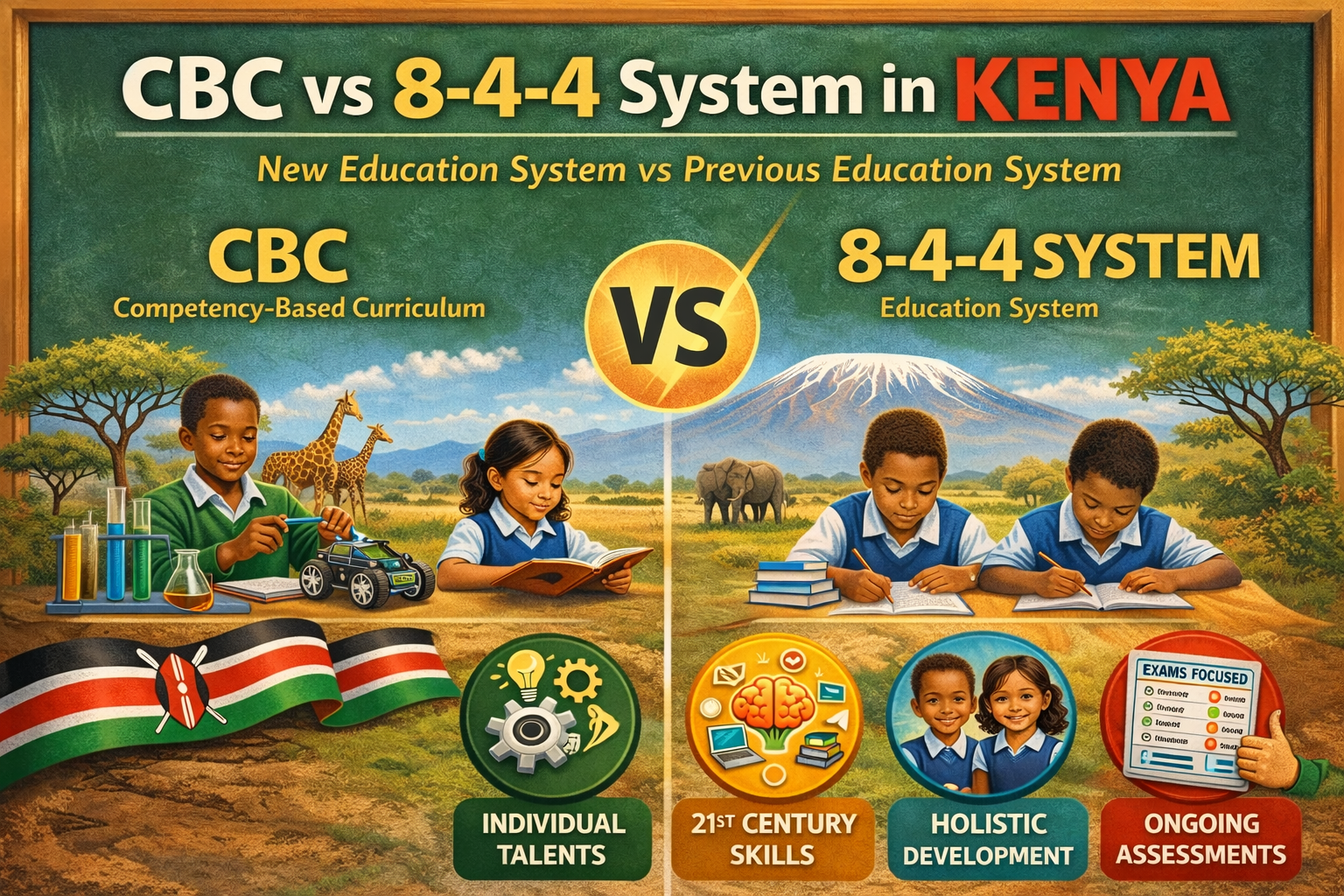
Traditional 8-4-4 Approach: Teacher writes multiplication problems on the board. Children copy them and practice. Teacher checks answers and marks them right or wrong. Children receive percentage scores.
CBC/CBE Approach: Teacher presents a real scenario: “Your mother sends you to buy 4 packets of milk. Each packet costs 60 shillings. How much money do you need?”
Children work in groups using bottle caps or stones to represent money. They discuss strategies and present solutions. Teacher observes who understands multiplication concepts, who can apply them to real situations, and who needs more support.
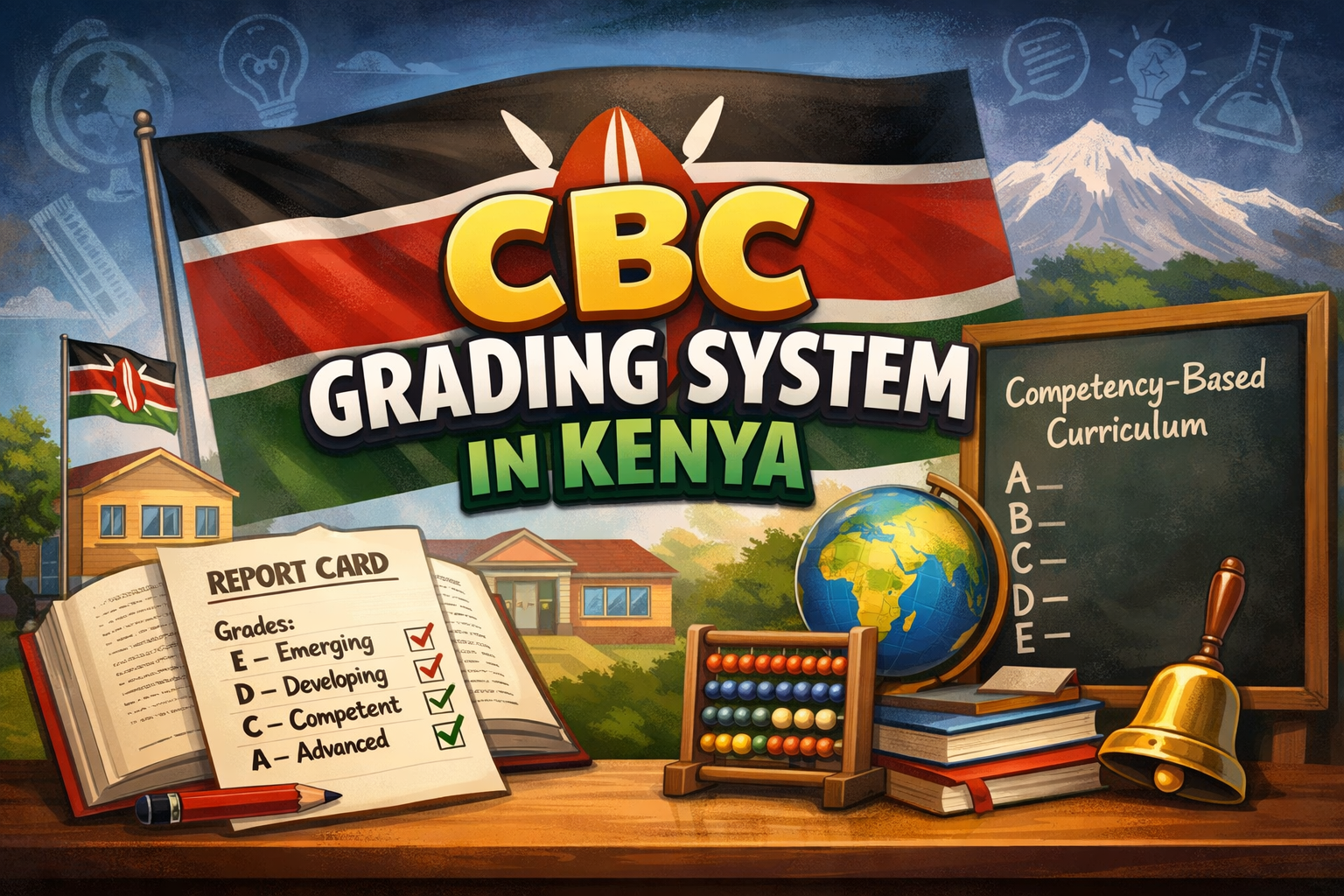
Assessment is continuous through observation. Teacher notes which learners are “Exceeding Expectations” (solve quickly and explain clearly), “Meeting Expectations” (solve with some guidance), “Approaching Expectations” (need significant help), or “Below Expectations” (don’t grasp the concept yet).
The focus is on demonstrating competency in applying multiplication, not just getting an answer right.
Example 2: Grade 7 Science Practical
Traditional Approach: Teacher demonstrates an experiment while students watch. Students write notes about what they observed. They memorize the procedure and results for the exam.
CBC/CBE Approach: Students design and conduct their own experiments in groups. They hypothesize what will happen, gather materials (including locally available items), perform the experiment, observe results, and draw conclusions.
Teacher assesses multiple competencies: scientific thinking, practical skills, teamwork, communication (when presenting findings), and problem-solving (when things don’t go as expected).
Assessment uses a rubric considering design quality, execution, analysis, and presentation. Students also assess their own work and their peers’ work, developing critical evaluation skills.
Example 3: Pre-Primary Learning
Traditional Approach: Children sit at desks while teacher shows flashcards of letters and numbers. They repeat after the teacher and practice writing on slates.
CBC/CBE Approach: Children engage in play-based activities. They might build with blocks (developing spatial awareness and motor skills), role-play shopping (learning numbers and social skills), or plant seeds in the school garden (science concepts and responsibility).
Teacher observes and notes developmental milestones: Can the child count to 10? Do they interact cooperatively? Can they follow instructions? Have their fine motor skills developed appropriately?
Assessment is entirely observational, developmental, and descriptive—no tests or grades, just noting each child’s progress.
What Parents Should Know
Supporting CBC and CBE at Home
Understand the Difference Recognize that when schools talk about “CBC,” they’re referring to Kenya’s curriculum. When they mention “competency-based approaches,” they’re talking about CBE principles. Both aim to help your child develop real skills.
Value Skills Over Scores Rather than asking “What marks did you get?” ask “What can you do now that you couldn’t do before?” This shift in thinking aligns with CBC’s competency focus.
Support Practical Learning When your child has projects or practical assignments, provide materials and encouragement. These activities develop competencies that tests alone cannot measure.
Be Patient with the System CBC implementation faces challenges, and schools are learning as they go. Work with teachers constructively rather than resisting change because it’s unfamiliar.
Participate in School Activities Attend parent meetings where CBC is explained. Ask questions. Understand how your child is assessed and what you can do to support learning at home.
Addressing Common Worries
“Will CBC really work?” No education system is perfect, but CBC addresses real weaknesses in 8-4-4. With proper resources and implementation, competency-based approaches have succeeded globally.
“What about university admission?” Universities are adapting admission criteria to work with CBC. Your child’s CBC qualifications will be recognized just as 8-4-4 certificates were.
“Is my child falling behind?” If your child consistently “Meets Expectations” in CBC, they’re progressing appropriately. Don’t measure CBC success by 8-4-4 standards.
What Teachers Should Know
Effective CBC Implementation in Your Classroom
Embrace CBE Philosophy Successful CBC teaching requires believing in competency-based principles. If you teach CBC content using old methods, learners won’t develop the intended competencies.
Plan for Competency Development Each lesson should target specific competencies. Ask yourself: “By the end of this lesson, what should learners be able to do?”
Use Varied Assessment Don’t rely only on written tests. Observe learners during activities, review portfolios, conduct practical assessments, and use peer and self-assessment.
Provide Continuous Feedback Don’t wait until exams to tell learners how they’re doing. Give immediate feedback that helps them improve while learning is happening.
Collaborate with Colleagues Share CBC implementation experiences, challenges, and solutions. Collaborative planning and team teaching can ease the transition.
Engage Parents Help parents understand CBC through meetings, newsletters, or individual conversations. Parental support significantly improves implementation success.
Professional Development
Take advantage of every CBC training opportunity offered by KICD, TSC, or your school. Stay updated on curriculum changes and best practices. Join teacher networks—online or in-person—where CBC experiences are shared.
What Students Should Know
Your Learning in CBC
Focus on Mastery CBC wants you to truly understand and be able to do things, not just memorize for tests. Take time to really learn each skill before moving on.
Different Paths Are Valid Whether you’re interested in science, arts, sports, or technical subjects, CBC values your path. You don’t have to pursue only “academic” subjects to succeed.
Ask for Help If you haven’t mastered a competency, it’s okay to ask for more support. CBC recognizes that everyone learns at different speeds.
Participate Actively CBC learning works best when you engage, ask questions, work with classmates, and try practical activities. Don’t just sit and listen passively.
Track Your Progress Keep your portfolio organized. Look back at earlier work to see how much you’ve grown. Celebrate your progress in developing competencies.
Frequently Asked Questions (FAQs)
What is the main difference between CBE and CBC?
CBE (Competency-Based Education) is the global educational philosophy emphasizing mastery of skills and knowledge over time spent in class. CBC (Competency-Based Curriculum) is Kenya’s specific curriculum framework that implements CBE principles in Kenyan schools. Essentially, CBE is the approach or philosophy, while CBC is Kenya’s practical application of that philosophy through a structured 2-6-3-3-3 curriculum designed by KICD.
Is CBC the same as CBE in Kenya?
CBC is Kenya’s implementation of CBE, so while they’re closely related, they’re not exactly the same. CBE is the broader international concept of competency-based education, while CBC is the specific Kenyan curriculum framework following CBE principles. When people in Kenya talk about “CBC,” they’re usually referring to the whole package—both the curriculum structure and the competency-based teaching approach.
Why did Kenya adopt CBC instead of continuing with 8-4-4?
Kenya adopted CBC to address serious weaknesses in the 8-4-4 system: over-emphasis on exams rather than skills, limited pathways to success (mostly pushing learners toward university), inadequate development of practical and technical skills, high youth unemployment due to graduates lacking job-ready competencies, and misalignment with modern economic needs. CBC implementation aims to produce well-rounded, competent citizens with diverse skills matching 21st-century requirements and Kenya’s Vision 2030 goals.
How long will CBC implementation take in Kenya?
Full CBC implementation will take until at least 2029, when the first cohort that started in 2017 completes Grade 12 and sits for the reformed KCSE examination. However, implementation is ongoing—each year brings new challenges and adjustments as learners progress through the system. Even after 2029, refinements will continue as Kenya gains more experience with CBC at all levels.
What challenges does CBC face in Kenya’s education system?
Key challenges include inadequate infrastructure (especially for Junior Secondary), insufficient learning resources in many schools, variable teacher preparedness and training quality, budget constraints limiting full implementation, confusion among parents about how CBC works, transition difficulties for first cohorts navigating a new system, and the complexity of implementing true competency-based assessment at scale. Despite these challenges, stakeholders continue working to improve CBC implementation.
Can students transition between CBC and other education systems?
This is complex and depends on timing and circumstances. Students who started in 8-4-4 typically continue in that system. Students in CBC who move abroad may need bridging programs since each country’s curriculum differs. As CBC becomes Kenya’s standard, regional harmonization discussions are happening, particularly within the East African Community. Parents considering international transitions should consult with education officials and receiving institutions about recognition and bridging requirements for specific situations.
Conclusion
Understanding CBE vs CBC in Kenya clarifies that these aren’t competing systems but complementary parts of Kenya’s education transformation. CBE provides the philosophical foundation—the belief that education should develop demonstrable competencies rather than just transmit information. CBC is Kenya’s practical implementation of those principles through a carefully structured curriculum framework.
The difference between CBE and CBC matters for clarity but in practice, they work together seamlessly. When KICD designs learning outcomes, when teachers assess competencies, when learners demonstrate skills—that’s both CBE philosophy and CBC framework in action.
Kenya’s education system under CBC implementation faces real challenges, from infrastructure gaps to teacher training needs. However, the fundamental shift toward competency-based approaches addresses genuine weaknesses in the previous 8-4-4 system. By emphasizing what learners can actually do rather than just what they can memorize, CBC better prepares Kenyan children for diverse, successful futures.
For parents, understanding that CBC operationalizes CBE principles helps make sense of new assessment methods and learning approaches. For teachers, recognizing this connection supports effective implementation. For students, whether you call it CBC or CBE, the focus remains clear: developing real skills, knowledge, and attitudes that will serve you throughout life.
As CBC implementation continues maturing, Kenya joins global efforts to make education more relevant, effective, and aligned with 21st-century needs. Both CBE and CBC represent Kenya’s commitment to quality education that truly prepares young people for the opportunities and challenges ahead.