How to Check KCSE Results Online: Complete Guide for Kenyan Students and Parents
Get High Paying Surveys
Earn money online by completing simple surveys. No experience needed.
Start Earning →Learning how to check KCSE results online is crucial for every Form Four graduate eagerly awaiting their Kenya Certificate of Secondary Education examination outcome. The Kenya National Examinations Council provides multiple convenient methods for candidates to access their results quickly and securely through the official KCSE results portal, SMS services, and school-based collection. This comprehensive guide walks you through every step of KNEC results checking, explains what to expect when results are released, how to interpret your results slip, and what to do after receiving your grades. Whether you’re a student anxiously waiting for your exam results Kenya or a parent supporting your child through this important milestone, this article provides accurate, step-by-step instructions to help you access and understand your KCSE results with confidence.
Understanding KCSE Results Release in Kenya
The release of KCSE results is one of the most anticipated moments in every Kenyan student’s academic journey, marking the culmination of four years of secondary education and opening doors to future opportunities.

When Are KCSE Results Released?
KNEC typically releases KCSE results approximately two to three months after the completion of examinations. Since KCSE exams usually conclude in late November, results are generally announced between late December and early January of the following year. The exact release date is determined by the Cabinet Secretary for Education and announced publicly through official channels.
The results release follows a standardized process involving thorough marking by trained examiners, quality assurance checks to ensure accuracy, data compilation and verification, security clearances to prevent leaks, and final approval by relevant education authorities before public announcement.
Official Announcement Channels
When KCSE results are ready for release, the Ministry of Education issues an official public announcement through national media outlets including television and radio, major Kenyan newspapers, the official KNEC website, verified Ministry of Education social media accounts, and direct communication to schools through county and sub-county education offices.
Students and parents should rely only on these official channels for results release information. Rumors and fake announcements often circulate on social media before the official release, causing unnecessary anxiety and confusion.
Get High Paying Surveys
Earn money online by completing simple surveys. No experience needed.
Start Earning →
How to Check KCSE Results Online Through the Official Portal
The KCSE results portal is the primary and most reliable method for checking exam results online. This secure platform allows candidates to access their individual results directly.
Step-by-Step Guide to Online Results Checking
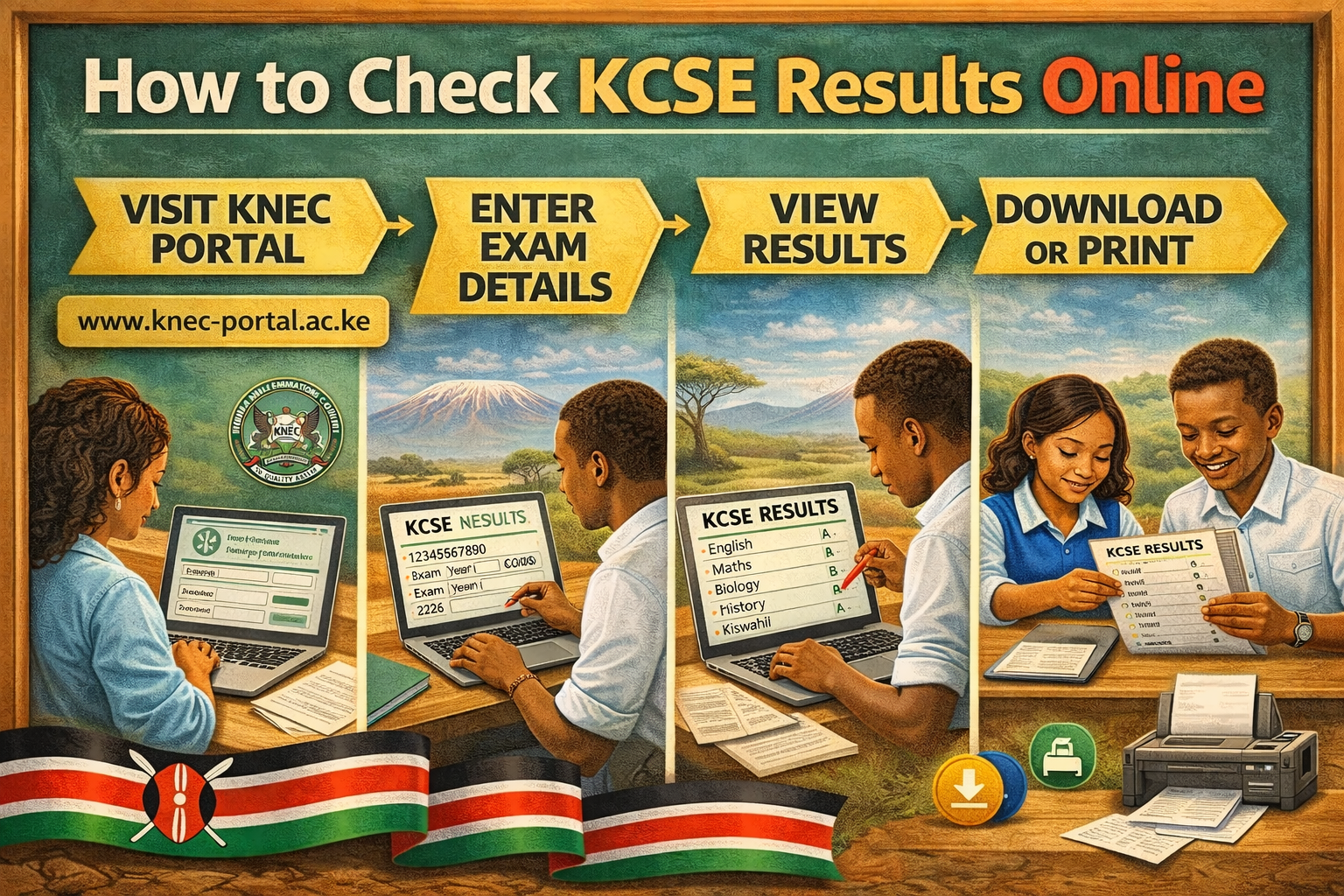
Step 1: Wait for Official Announcement
Do not attempt to check results before the official release announcement. The portal only becomes active after the Cabinet Secretary for Education makes the public announcement. Attempting to access results before this time will not work and may expose you to fraudulent websites.
Step 2: Visit the Official KNEC Website
Open your web browser and navigate to the official KNEC website at www.knec.ac.ke. Ensure you type the URL correctly to avoid phishing websites that mimic the official portal. Look for the secure padlock symbol in your browser’s address bar confirming you’re on a legitimate secure website.
Step 3: Locate the Results Portal Link
Get High Paying Surveys
Earn money online by completing simple surveys. No experience needed.
Start Earning →
On the KNEC homepage, look for a clearly marked link or button directing you to the KCSE results portal. This is usually prominently displayed on the homepage during the results release period. The link might read “KCSE Results,” “Check Results,” or “Examination Results Portal.”
Step 4: Enter Your Details
The KCSE results portal requires specific information to retrieve your results securely. You will need to enter your index number exactly as it appears on your examination slip, your year of examination, and possibly other verification details such as your birth certificate number or national ID number. Ensure all information is entered accurately as even small errors will prevent results retrieval.
Get High Paying Surveys
Earn money online by completing simple surveys. No experience needed.
Start Earning →Step 5: Submit and View Results
After entering all required information, click the submit or check results button. The system will verify your details and display your results if the information matches their database. Your results will appear showing your performance in each subject, your overall grade, and your mean grade point.

Step 6: Download and Save Your Results
Most results portals allow you to download a PDF copy of your results slip. Click the download button and save this document to your device. Print multiple copies for your records as you will need them for university applications, college enrollment, and other official purposes.
Technical Requirements for Online Checking
To check KCSE results online successfully, you need a device with internet access such as a smartphone, tablet, or computer, a stable internet connection to prevent interruption during the checking process, an updated web browser (Chrome, Firefox, Safari, or Edge), and your examination details readily available.
If you lack personal internet access, you can visit cybercafes, access results at school where computers are usually made available, use public libraries or community centers with internet facilities, or ask a trusted friend or family member with internet access to help you.
How to Check KCSE Results via SMS
The KCSE results SMS service provides a convenient alternative for candidates who prefer mobile access or lack reliable internet connectivity.
SMS Results Checking Process
When KNEC activates the SMS results service, candidates can access their results by sending a specially formatted text message to the designated KNEC shortcode. The specific format and shortcode are announced alongside the results release.
The typical SMS format follows this pattern: Send your index number to the official KNEC shortcode announced during results release. For example, if the shortcode is 20076 and your index number is 12345678, you would send “12345678” to 20076.
Within moments, you will receive a return SMS containing your KCSE results summary including your performance in each subject and your overall mean grade. This service usually operates on major Kenyan mobile networks including Safaricom, Airtel, and Telkom Kenya.
SMS Service Costs and Accessibility
The KCSE results SMS service typically costs a small fee per message, usually around Ksh 25 to Ksh 50 depending on the mobile network provider. This fee is deducted from your mobile phone airtime balance. Ensure you have sufficient airtime before sending the results request SMS.
The SMS method works on any mobile phone, including basic feature phones that cannot access the internet, making it accessible to students in areas with limited internet infrastructure but good mobile network coverage.
Important SMS Checking Tips
Send your SMS only after the official results release announcement, as the service is not active before this time. Use the exact shortcode announced by KNEC, as fake shortcodes operated by scammers sometimes circulate on social media. Ensure your index number is entered correctly without spaces or additional characters. If you don’t receive a response within a few minutes, check your network connection and try again, or use an alternative checking method.
Checking KCSE Results Through Your School
Many students prefer collecting their results directly from their schools, which remains a valid and often preferred method despite digital alternatives.
School-Based Results Collection
Schools receive official hard-copy result slips from KNEC through county education offices shortly after the public release announcement. These physical documents are the original certified copies of your results and carry official KNEC authentication marks.
Schools typically organize results collection days where candidates return to receive their results personally. The school administration announces the specific dates and times for results collection, usually within a few days after the official release.
What to Bring When Collecting Results
When going to collect your KCSE results from school, remember to bring your national identification card or birth certificate for identity verification, your examination slip or candidate card if you still have it, and a guardian or parent if you are under 18 years, as some schools require this.
Schools may also require you to complete a results collection register, sign for receipt of your results slip, settle any outstanding school fees or obligations before receiving results, and in some cases, attend a briefing session about next steps for further education or training.
Benefits of School Collection
Collecting results from school offers several advantages including receiving the original certified hard copy needed for official applications, getting immediate guidance from teachers on interpreting results and making informed decisions about next steps, accessing career counseling and information about university and college options, connecting with classmates to celebrate or support each other, and clarifying any questions about subject grades or grading directly with school administrators.
Understanding Your KCSE Results Slip
Once you access your KCSE results through any method, understanding what the information means is essential for making informed decisions about your future.
Components of the Results Slip
Your official KCSE results slip contains several important elements. At the top, you’ll find your personal details including full name, index number, school name and code, and year of examination. The main section shows your subject performance listing each subject you sat for, the grade achieved in that subject (A, A-, B+, B, B-, C+, C, C-, D+, D, D-, or E), and the corresponding grade points for each subject.
The results slip also displays your aggregate points calculated by adding points from your best seven subjects, your mean grade which is the average performance across your best seven subjects expressed as a letter grade, and your overall position indicator showing your performance level.
KCSE Grading System
KCSE uses a twelve-point grading scale where A represents 12 points indicating excellent performance (80-100 percent), A- represents 11 points (75-79 percent), B+ represents 10 points (70-74 percent), B represents 9 points (65-69 percent), B- represents 8 points (60-64 percent), C+ represents 7 points (55-59 percent), C represents 6 points (50-54 percent), C- represents 5 points (45-49 percent), D+ represents 4 points (40-44 percent), D represents 3 points (35-39 percent), D- represents 2 points (30-34 percent), and E represents 1 point (0-29 percent).
Your mean grade is calculated by dividing your total points from your best seven subjects by seven, then rounding to determine the corresponding letter grade. For example, if your total points from seven subjects is 63, your mean grade calculation would be 63 ÷ 7 = 9, which corresponds to a mean grade of B plain.
Interpreting Your Results for Future Planning
Different mean grades open different pathways for further education and career opportunities. A mean grade of C+ (plus) and above qualifies you for direct university entry through the Kenya Universities and Colleges Central Placement Service (KUCCPS). Grades between C- (minus) and C (plain) qualify for diploma programs in various technical and vocational institutions. D+ (plus) and above qualifies for certificate courses in polytechnics and vocational training centers.
However, specific courses have additional subject requirements beyond the mean grade. For instance, engineering courses typically require good grades in Mathematics and Physics, medical programs require strong performance in Biology and Chemistry, and teaching programs consider your performance in the teaching subjects you wish to specialize in.
Common Problems and Solutions When Checking KCSE Results
Website Overload and Slow Loading
The KCSE results portal experiences extremely high traffic immediately after results release as thousands of candidates try to access their results simultaneously. This often causes the website to load slowly or temporarily become unavailable.
If you encounter slow loading or error messages, remain patient and try these solutions: wait for 30 minutes to an hour and try again when traffic reduces, attempt to access the portal during off-peak hours like early morning or late evening, use the SMS method as an alternative, or visit your school to collect physical results if digital access proves difficult.
Avoid refreshing the page repeatedly as this contributes to server overload. Instead, wait for the page to load completely before taking any action.
Incorrect Index Number or Details
If the portal indicates your index number is not found or details are incorrect, verify that you entered your index number exactly as it appears on your examination slip without adding spaces or dashes, ensure you selected the correct examination year, check that you haven’t confused similar-looking characters like O (letter) and 0 (zero) or I (letter) and 1 (number).
If problems persist despite correct entry, contact your school administration or visit the nearest KNEC office with your examination slip for assistance.
Missing or Withheld Results
In rare cases, some candidates may find their results have been withheld. This can happen due to examination irregularities under investigation, incomplete examination papers, outstanding issues with examination fees, or administrative errors requiring verification.
If your results are withheld, KNEC will provide information about why and what steps you need to take. Contact your school principal immediately for guidance, and if necessary, visit the KNEC offices with all relevant documentation for clarification.
Network and Technical Issues
Mobile network problems can prevent SMS results checking. If your SMS doesn’t go through or you don’t receive a response, ensure you have sufficient airtime balance, check that you have network coverage, verify you’re using the correct shortcode announced by KNEC, or try using a different mobile network if available.
For online checking issues related to device or browser problems, try using a different web browser, clear your browser cache and cookies, ensure your device’s operating system is updated, or use a different device if the problem persists.
Security and Fraud Prevention
Avoiding Fake Results Portals
Scammers create fraudulent websites that mimic the official KNEC portal to steal personal information or money from unsuspecting candidates. Protect yourself by only using the official KNEC website at www.knec.ac.ke, verifying the website has a secure connection (https:// and padlock symbol), never paying money to access results (KNEC does not charge for online results checking), and ignoring links sent via social media or text messages claiming to provide early access to results.
Protecting Your Personal Information
Your examination index number and personal details should be kept confidential. Do not share your index number publicly on social media, be cautious about who helps you check results, avoid checking results on public computers without logging out and clearing browsing history, and keep your results slip secure as it contains information that could be misused.
Recognizing Result Manipulation Scams
After results release, scammers often contact candidates claiming they can change or improve grades for a fee. These are fraudulent schemes. KCSE results are final once released and cannot be changed except through the official results verification or remarking process administered by KNEC. Never send money to anyone claiming they can alter your results. Report such scams to KNEC and relevant authorities.
What to Do After Receiving Your KCSE Results
Immediate Steps
Once you receive your results, make several copies of your results slip for various applications and keep the original safe. Review your performance across all subjects to understand your strengths and areas where you performed below expectations. Compare your grades with university and college requirements for courses you’re interested in pursuing.
If you’re satisfied with your results, begin preparing for the next steps including KUCCPS application for university placement, researching colleges and courses that match your qualifications, gathering other necessary documents like birth certificate and national ID for applications, and considering career guidance to make informed choices.
If You’re Unhappy with Your Results
Disappointing results can be emotionally challenging, but several options exist. You can apply for results verification where KNEC rechecks the accuracy of your marks and grade calculation for a fee. This doesn’t involve remarking but ensures no errors occurred in compiling your results.
You can also consider registering as a private candidate to retake KCSE in the following year to improve specific subject grades. Many candidates successfully improve their performance through focused retake preparation.
Alternatively, explore training opportunities suited to your current grades. Many certificate and diploma programs offer excellent career pathways and some allow progression to higher qualifications later.
Planning Your Education and Career Path
Use your KCSE results as a foundation for planning rather than a limitation. Research institutions offering programs you qualify for, attend career guidance sessions and education fairs, consult with teachers and education counselors about realistic options, consider your interests and strengths alongside your grades, and explore both academic and technical training pathways based on your career goals.
Remember that KCSE results are just one step in your educational journey. Many successful Kenyans achieved their goals through diverse pathways beyond direct university entry.
Frequently Asked Questions (FAQs)
How do I check KCSE results online?
To check KCSE results online, visit the official KNEC website at www.knec.ac.ke after the Cabinet Secretary for Education announces the official results release. Click on the KCSE results portal link on the homepage, enter your examination index number and other required verification details exactly as they appear on your examination slip, then submit to view your results. You can download a PDF copy of your results slip for your records and future use in applications.
What is the KCSE results portal and how does it work?
The KCSE results portal is the official online platform operated by KNEC where candidates can access their examination results securely. The portal uses your unique index number and other personal details to authenticate your identity and retrieve your specific results from the KNEC database. The portal becomes active only after official results release and provides secure access to view, download, and print your certified results slip, which shows your performance in each subject, grade points, and overall mean grade.
Can I check KCSE results using SMS?
Yes, KNEC provides an SMS service for checking KCSE results through mobile phones. To use this service, send your examination index number to the official KNEC shortcode announced during results release. The service typically costs between Ksh 25 to Ksh 50 depending on your mobile network provider, deducted from your airtime balance. You will receive a return SMS containing your results summary including subject grades and mean grade within a few minutes.
When are KCSE results released each year?
KCSE results are typically released approximately two to three months after examinations conclude. Since KCSE exams usually end in late November, results are generally announced between late December and early January of the following year. The exact release date varies annually and is officially announced by the Cabinet Secretary for Education through national media, the KNEC website, and official government communication channels. Students should monitor these official channels for the confirmed announcement.
What should I do if I can’t access my KCSE results online?
If you cannot access your results online due to technical difficulties, network problems, or website overload, try several alternatives: use the SMS checking method by sending your index number to the official KNEC shortcode, wait and retry during off-peak hours when website traffic is lower, visit your secondary school to collect your physical results slip directly from the administration, or ask a trusted person with reliable internet access to help you check online. Schools always receive hard-copy results slips that you can collect in person.
Are online KCSE results official and acceptable for applications?
Yes, the results accessed through the official KNEC portal are authentic and accurate. However, for university applications, college enrollment, and other official processes, you typically need the original certified hard-copy results slip that schools distribute. The online version serves as an immediate way to view your results and plan next steps, while the physical slip provides the official certification with KNEC security features required for formal applications. Always collect your original results slip from your school for official use.
Conclusion
Knowing how to check KCSE results online empowers you to access your examination outcome quickly and conveniently through the official KCSE results portal, SMS services, or school collection. Whether you choose digital or traditional methods for KNEC results checking, the most important factor is using official channels to ensure you receive accurate, secure results. Your KCSE results represent years of hard work and open doors to numerous opportunities in higher education, technical training, and career development.
As you await and eventually access your exam results Kenya, remember that results are not the final measure of your potential but rather one step in your educational journey. Regardless of your performance, multiple pathways exist for achieving your goals through universities, colleges, vocational training, or alternative routes. Approach your results with balanced perspective, seek guidance from trusted educators and counselors, and make informed decisions about your future based on both your results and your personal interests and strengths. Success comes in many forms, and your dedication to continuous learning and growth matters far more than any single examination outcome.
Get High Paying Surveys
Earn money online by completing simple surveys. No experience needed.
Start Earning →