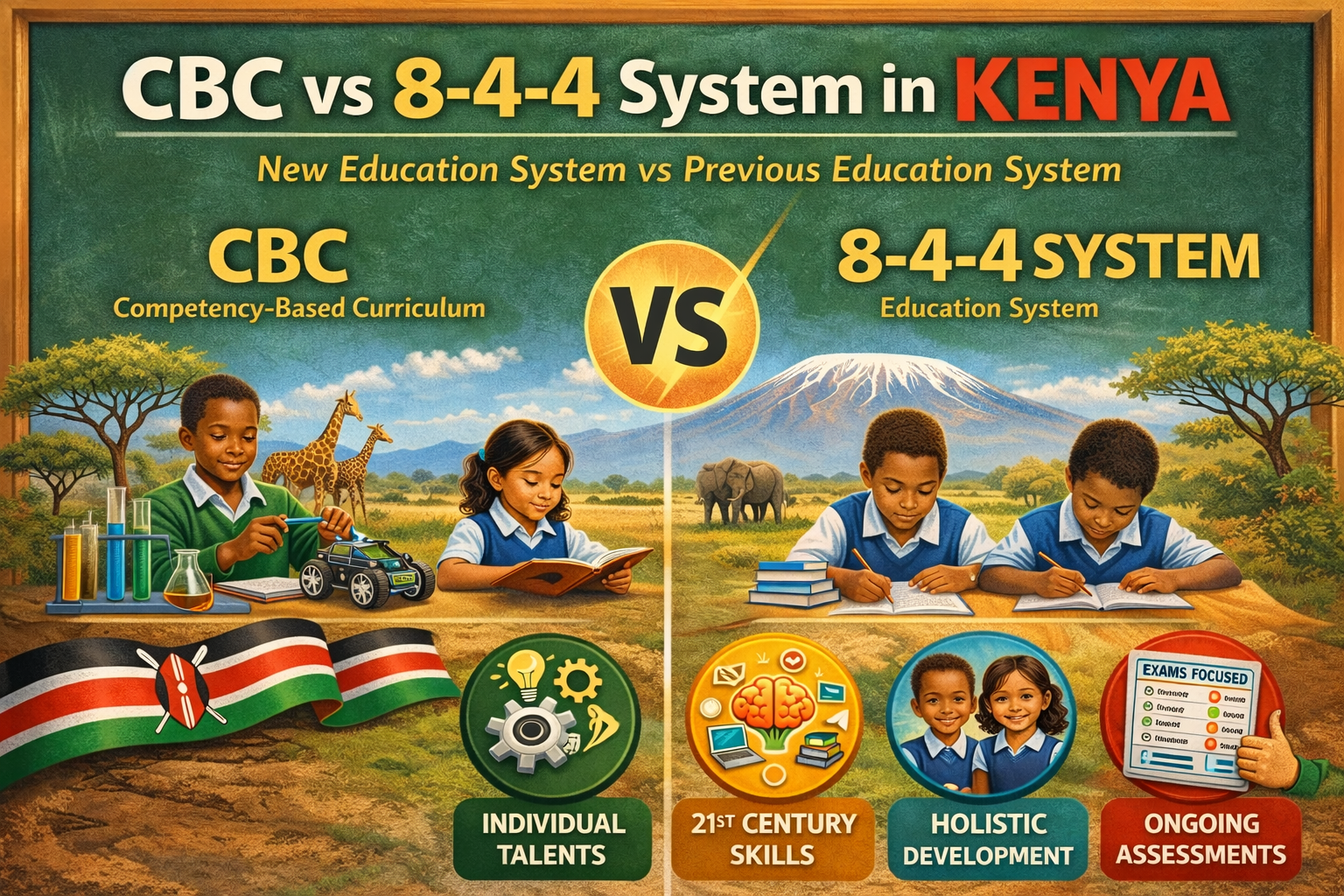
CBC vs 8-4-4 System in Kenya: Complete Comparison and Why the Change Happened
Get High Paying Surveys
Earn money online by completing simple surveys. No experience needed.
Start Earning →For decades, Kenyan parents, students, and teachers knew exactly how education worked: eight years of primary school, four years of secondary, four years of university. The 8-4-4 system was familiar, predictable, and shaped the education of millions of Kenyans from 1985 to 2017. Then came CBC, and suddenly everything changed.
Understanding CBC vs 8-4-4 system Kenya helps explain one of the most significant transformations in the country’s history. Many parents wonder: Why abandon a system we knew? What makes CBC better? Was 8-4-4 really that bad? The difference between CBC and 8-4-4 goes far deeper than just changing from 8-4-4 to 2-6-3-3-3 years—it represents a fundamental shift in what education means and how learning happens.

This article provides a complete comparison of both systems, examining structure, teaching methods, assessment, and outcomes. We’ll explore the 8-4-4 challenges that prompted reform, the CBC advantages that justified the change, and how both systems fit into Kenya’s broader education system Kenya has developed over decades. Whether you studied under 8-4-4 and want to understand what your children experience, or you’re simply curious about this educational transformation, this guide explains everything you need to know.
Understanding the 8-4-4 System
Origins and Structure
The 8-4-4 system was introduced in Kenya in 1985, replacing the previous 7-4-2-3 system inherited from British colonial education. The name describes its structure:
8 years of Primary School
- Standards 1-8 (later called Classes 1-8)
- Ages approximately 6-14
- Ended with Kenya Certificate of Primary Education (KCPE) exam
4 years of Secondary School
Get High Paying Surveys
Earn money online by completing simple surveys. No experience needed.
Start Earning →
- Forms 1-4
- Ages approximately 14-18
- Ended with Kenya Certificate of Secondary Education (KCSE) exam
4 years of University
- Undergraduate degree programs
- Ages approximately 18-22
- Various professional and academic paths
Total education cycle: 16 years from primary entry to university graduation.
Key Features of 8-4-4
Exam-Centered Approach The 8-4-4 system was heavily examination-focused. Two national exams—KCPE after primary and KCSE after secondary—determined learners’ futures. KCPE scores determined which secondary school a child could attend, while KCSE scores determined university placement and career options.
Academic Emphasis 8-4-4 prioritized academic subjects: mathematics, sciences, languages, humanities. While practical subjects existed (agriculture, home science, art, music), they were often marginalized or poorly resourced compared to “core” academic subjects.
Content-Heavy Curriculum The curriculum was loaded with content. Learners covered vast amounts of material across many subjects. The focus was breadth of knowledge rather than depth of understanding or skill application.
Teacher-Centered Instruction Teaching typically involved teachers presenting information while students listened, took notes, and practiced exercises. The teacher was the authority who transmitted knowledge to passive learners.
Get High Paying Surveys
Earn money online by completing simple surveys. No experience needed.
Start Earning →
Uniform Pathway Until Form 3, all students followed essentially the same curriculum. Subject choices were limited, and the system pushed most learners toward university as the primary success measure.
What 8-4-4 Aimed to Achieve
When introduced, 8-4-4 had noble goals:
- Eliminate colonial system remnants
- Provide practical skills alongside academics
- Address unemployment by including vocational elements
- Align education with Kenya’s development needs
- Reduce education costs and time
Some of these goals were partially achieved, but over three decades, significant problems emerged.
Get High Paying Surveys
Earn money online by completing simple surveys. No experience needed.
Start Earning →The 8-4-4 Challenges That Led to Reform
Excessive Exam Pressure
High-Stakes Testing The most criticized aspect of 8-4-4 was its reliance on high-stakes national examinations. KCPE and KCSE weren’t just assessments—they were gatekeepers determining children’s entire futures.
A single exam after eight years of primary school decided whether a child attended a national school, county school, or struggled to find any secondary placement. The pressure was immense, sometimes unbearable.

Stress and Mental Health Issues Exam pressure contributed to anxiety, depression, and stress-related health problems among learners. Stories of children falling ill during exam periods, experiencing breakdowns, or even contemplating suicide due to exam fear were tragically common.
Parents also experienced severe stress, sometimes pressuring children excessively or investing heavily in private tuition to improve exam chances.
Cramming Culture Rather than genuine learning, 8-4-4 often encouraged cramming—memorizing information just long enough to pass exams, then forgetting it. Students could recite historical dates, mathematical formulas, or scientific facts for exams without understanding concepts or being able to apply knowledge.
Limited Skill Development
Theory Over Practice Despite 8-4-4’s original intention to include practical skills, implementation emphasized theory. Science classes often involved reading about experiments rather than conducting them. Technical subjects lacked equipment and resources, reducing them to theoretical instruction.
Unemployable Graduates A cruel paradox emerged: educated unemployment. Kenya produced thousands of secondary and university graduates who couldn’t find jobs because they lacked practical skills employers needed.
Graduates could recite textbook knowledge but often couldn’t write professional emails, work in teams, solve real problems, or apply theoretical knowledge to workplace situations. The 8-4-4 challenges created a mismatch between education outputs and economic needs.
Neglected Talents Children with talents in arts, sports, technical work, or practical skills often felt marginalized. If you couldn’t excel in academic exams, 8-4-4 offered few recognized pathways to success. Many talented individuals dropped out or disengaged because their abilities weren’t valued.
Narrow Definition of Success
University or Failure 8-4-4 implicitly defined success as university admission, preferably to prestigious programs like medicine, engineering, or law. Any other outcome—technical training, artistic pursuits, entrepreneurship—was considered second-best or even failure.
This narrow definition was economically irrational. Kenya needs skilled artisans, technicians, farmers, artists, and entrepreneurs just as much as doctors and lawyers. But 8-4-4’s prestige hierarchy didn’t recognize this.
Ranking and Competition Schools were ranked by KCPE and KCSE mean scores. Children were ranked against classmates. This competitive ranking created winners and losers, often damaging self-esteem and relationships.
Parents compared children: “Your cousin scored 380 on KCPE, why did you only get 320?” This comparison culture hurt many children whose strengths lay outside academic exam performance.
Overloaded Curriculum
Too Much Content 8-4-4 curriculum tried to cover vast amounts of material. Teachers rushed through topics to complete syllabi before exams. Depth of understanding was sacrificed for breadth of coverage.
Learners memorized facts they’d never use, studied content disconnected from their lives, and felt overwhelmed by the sheer volume of information to absorb.
Limited Time for Deep Learning With so much content to cover, little time remained for exploration, inquiry, projects, or applying knowledge. Learning became a race to finish syllabi rather than a journey of discovery and understanding.
Inequitable Outcomes
Resource Disparities 8-4-4 outcomes varied dramatically based on school resources. Well-equipped schools in urban or wealthy areas produced high exam scores. Under-resourced rural schools struggled, creating educational inequality that reinforced socioeconomic disparities.
Gender Gaps While Kenya made progress on gender parity in enrollment, 8-4-4 didn’t adequately address how exam pressure and curriculum design affected boys and girls differently. Dropout rates, particularly among girls in secondary school, remained concerning.
Understanding the CBC System
Origins and Structure
The Competency-Based Curriculum (CBC) was introduced in 2017 after extensive consultation, research, and planning by the Kenya Institute of Curriculum Development (KICD) and the Ministry of Education. CBC represents Kenya’s adoption of competency-based education principles used successfully in many countries.
2-6-3-3-3 Structure
- 2 years Pre-Primary (PP1 and PP2)
- 6 years Primary (Grades 1-6)
- 3 years Junior Secondary (Grades 7-9)
- 3 years Senior Secondary (Grades 10-12)
- 3 years Tertiary education
Total: 17 years from pre-primary to tertiary completion.
Key Features of CBC
Competency-Based Approach CBC focuses on developing specific, measurable competencies—skills, knowledge, and attitudes learners can demonstrate. Success means being able to do things, not just knowing about them.
Continuous Assessment Rather than relying on one or two high-stakes exams, CBC uses continuous assessment throughout learning. Multiple forms of assessment—observation, projects, portfolios, practical demonstrations, and tests—build a comprehensive picture of each learner’s development.
Learner-Centered Methods CBC emphasizes active learning. Learners participate in hands-on activities, group work, projects, discussions, and problem-solving. Teachers facilitate learning rather than just transmitting information.
Multiple Pathways CBC recognizes diverse talents and interests. From Grade 7, learners begin choosing pathways aligned with their strengths. By senior secondary, four distinct pathways exist: STEM, Social Sciences, Arts and Sports Sciences, and Technical and Vocational.
Values and Character Development CBC deliberately integrates seven core values—love, responsibility, respect, unity, peace, patriotism, and integrity—throughout learning, not just as separate lessons.
Seven Core Competencies Every learning activity aims to develop one or more of seven competencies: communication and collaboration, critical thinking and problem-solving, creativity and imagination, citizenship, digital literacy, learning to learn, and self-efficacy.
Direct Comparison: CBC vs 8-4-4 System Kenya
Structure and Duration
8-4-4 System:
- Started at age 6 with Standard 1 (no formal pre-primary)
- 8 years primary, 4 years secondary, 4 years university
- Total: 16 years
- Two transition points: after primary, after secondary
CBC System:
- Starts at age 4-5 with Pre-Primary 1
- 2 years pre-primary, 6 years primary, 3+3 years secondary, 3 years tertiary
- Total: 17 years
- Three transition points: after primary, after junior secondary, after senior secondary
Why the Change? CBC recognizes early childhood education’s importance by formalizing pre-primary. The 3+3 secondary split allows for career pathway guidance from Grade 7 rather than waiting until Form 3, giving learners more time to develop specialized skills.
Teaching and Learning Approach
8-4-4:
- Teacher-centered: teacher talks, students listen
- Emphasis on content delivery and syllabus coverage
- Limited hands-on activities or projects
- Passive learning through lectures and notes
- Same instruction style for all learners
CBC:
- Learner-centered: students actively participate
- Emphasis on competency development and skill mastery
- Extensive hands-on activities, projects, and practical work
- Active learning through discovery, inquiry, and collaboration
- Differentiated instruction recognizing diverse learning styles
Classroom Example: Grade 4 Mathematics – Teaching Fractions
8-4-4 Approach: Teacher explains fractions on the blackboard, demonstrates examples, assigns textbook exercises. Students copy notes and practice similar problems.
CBC Approach: Teacher provides oranges, papers, or other materials. Students work in groups to divide items into equal parts, discover fraction concepts through manipulation, discuss their findings, create visual fraction representations, and apply fractions to real situations like sharing food or measuring ingredients.
Assessment Methods
8-4-4:
- Heavy reliance on end-of-term written exams
- Two major national exams (KCPE and KCSE) determining futures
- Percentage scores and ranking
- Limited formative assessment during learning
- Assessment separate from teaching
CBC:
- Continuous assessment throughout learning
- Multiple assessment methods: observation, portfolios, projects, practical tests, written tests
- Competency ratings: Exceeding Expectations, Meeting Expectations, Approaching Expectations, Below Expectations
- Extensive formative assessment informing instruction
- Assessment integrated into teaching process
What This Means: In 8-4-4, a child who performed poorly on exam day might receive a low mark regardless of their actual understanding. In CBC, that same child has multiple opportunities across various assessment types to demonstrate competency. Assessment becomes about showing what you can do, not just performing under exam pressure.
Subject Organization
8-4-4:
- Separate, distinct subjects: Mathematics, English, Kiswahili, Science, Social Studies, etc.
- Each subject taught in isolation
- Academic subjects prioritized over practical subjects
- Limited subject choice until Form 3
CBC:
- Learning areas that often integrate multiple subjects
- Cross-curricular connections emphasized
- Equal value for academic, practical, artistic, and technical areas
- Progressive subject choice from Grade 7 onwards
Example: Environmental Activities in CBC Lower Primary integrates what 8-4-4 separated into Science, Social Studies, Geography, and Religious Education. A lesson about water might cover scientific properties, social importance, geographical distribution, and stewardship values—all connected rather than isolated.
Career Preparation
8-4-4:
- Primarily prepared learners for university
- Technical/vocational subjects often marginalized
- Limited career guidance before Form 3 or 4
- One pathway dominated: academic subjects → university → professional employment
- Graduates often lacked practical job skills
CBC:
- Multiple valued pathways from Grade 7
- Technical and vocational education integrated and respected
- Career guidance begins in junior secondary
- Four pathways in senior secondary: STEM, Social Sciences, Arts and Sports, Technical and Vocational
- Emphasizes employability skills and competencies employers need
Impact: 8-4-4 created bottlenecks at university admission, with thousands of qualified applicants unable to access limited spaces. Many saw any non-university outcome as failure. CBC recognizes that skilled technicians, artisans, and TVET graduates are equally valuable and provides quality pathways for diverse careers.
Values and Character Education
8-4-4:
- Values taught primarily through Religious Education and Social Studies
- Often disconnected from daily learning
- Focus primarily on academic achievement
- Character development not systematically assessed
CBC:
- Seven core values integrated throughout all learning
- Values demonstrated in daily activities, not just taught theoretically
- Character development equally important as academic achievement
- Values and competencies assessed alongside knowledge
Learner Experience
8-4-4 Typical Learner:
- Focused heavily on passing exams
- Experienced high stress, especially in Standard 8 and Form 4
- Often memorized without understanding
- May have felt “stupid” if not academically gifted
- Limited recognition for non-academic talents
- Success measured by grades and rankings
CBC Typical Learner:
- Focuses on developing competencies and skills
- Experiences less exam-related stress (though not stress-free)
- Learns through application and practice
- Can succeed in multiple ways beyond academic performance
- Talents and interests recognized and developed
- Success measured by demonstrating competencies
The Difference Between CBC and 8-4-4: Summary Table
| Aspect | 8-4-4 System | CBC System |
|---|---|---|
| Structure | 8-4-4 (16 years) | 2-6-3-3-3 (17 years) |
| Teaching Approach | Teacher-centered, lecture-based | Learner-centered, activity-based |
| Assessment | Exam-focused, high-stakes tests | Continuous, multiple methods |
| Grading | Percentages and rankings | Competency ratings (EE, ME, AE, BE) |
| Focus | Content coverage and memorization | Competency development and application |
| Career Paths | Mainly academic → university | Multiple valued pathways (academic, technical, vocational, arts) |
| Practical Skills | Limited, often theoretical | Emphasized through hands-on learning |
| Talent Recognition | Primarily academic abilities | Diverse talents including arts, sports, technical |
| Values Education | Separate subjects | Integrated throughout learning |
| Stress Levels | High exam pressure | Reduced pressure, ongoing assessment |
| Success Definition | Exam scores and university admission | Demonstrated competencies across multiple areas |
| Employment Readiness | Often limited practical skills | Strong employability skills and competencies |
CBC Advantages Over 8-4-4
Reduced Pressure and Improved Wellbeing
CBC’s continuous assessment significantly reduces the extreme pressure that characterized 8-4-4. Children learn in healthier environments without constant fear of single exams determining their futures. Mental health benefits alone justify reform.
Better Skill Development
CBC learners develop critical thinking, creativity, collaboration, communication, and practical skills that 8-4-4 often neglected. These competencies prepare them for real-world challenges and employment.
Recognition of Diverse Talents
Unlike 8-4-4’s narrow academic focus, CBC values multiple forms of intelligence and ability. Whether a child excels in academics, arts, sports, or technical work, CBC provides recognized pathways to success.
Improved Career Preparation
CBC’s multiple pathways, integration of technical education, and emphasis on employability skills better prepare graduates for Kenya’s job market. The alignment between education outputs and economic needs reduces unemployment.
Deeper Learning
By emphasizing understanding and application over memorization, CBC produces learners who actually comprehend what they study and can use knowledge practically, not just recite it for exams.
Early Childhood Foundation
CBC’s formalization of pre-primary education ensures children enter primary school better prepared, with stronger foundations for subsequent learning.
Why 8-4-4 Lasted So Long Despite Challenges
If 8-4-4 had so many problems, why did it last over three decades? Several factors explain this:
Familiarity and Comfort People understood 8-4-4. It was predictable. Change is difficult, especially in something as fundamental as education.
Some Success Stories 8-4-4 did produce many successful Kenyans who became doctors, engineers, lawyers, teachers, and leaders. These successes made reform seem less urgent.
Resource and Capacity Constraints Implementing CBC requires significant resources, infrastructure, and teacher training. These requirements delayed reform until capacity developed.
Political and Policy Cycles Education reform requires sustained political will across multiple government cycles. Building consensus for change took time.
Incremental Improvements Rather than complete overhaul, many attempts were made to improve 8-4-4 incrementally, delaying recognition that fundamental restructuring was necessary.
Challenges in the CBC Transition
Implementation Difficulties
Infrastructure Gaps Many schools lack facilities CBC requires—science labs, computer rooms, technical workshops, adequate classrooms for Junior Secondary. Government and stakeholders continue addressing these gaps.
Resource Constraints CBC implementation costs exceed 8-4-4 operational costs. Budget limitations slow infrastructure development, material provision, and teacher training.
Teacher Preparation Not all teachers received adequate CBC training initially. Some struggle with learner-centered methods, continuous assessment, or new subjects. Ongoing professional development remains essential.
Transition Uncertainties
First Cohort Challenges The first CBC learners face unique uncertainties as systems are refined while they’re in school. Questions about examinations, university admission, and pathways create anxiety.
Parent Confusion Many parents don’t understand CBC because their own education was different. This leads to confusion about assessment, homework, or how to support children.
Assessment Complexity
Time-Intensive Evaluation CBC’s continuous, competency-based assessment requires more teacher time and effort than simply marking exams. Some teachers feel overwhelmed.
Subjectivity Concerns While rubrics guide assessment, some parents worry about consistency and fairness compared to “objective” exam percentages.
What the Future Holds
Long-Term Vision for Education System Kenya
CBC represents Kenya’s long-term vision for education aligned with global best practices and national development goals. As implementation matures, benefits should become increasingly evident.
Expected Outcomes:
- Graduates with skills matching economic needs
- Reduced unemployment through better career preparation
- Innovation and entrepreneurship driving economic growth
- Healthier learners with less exam-related stress
- Inclusive education valuing diverse talents and abilities
- Quality technical and vocational pathways alongside academic ones
Continuous Improvement
Education systems evolve continuously. CBC will likely see refinements based on experience, research, and changing needs. The key is maintaining core principles while addressing implementation challenges.
Areas for Ongoing Work:
- Infrastructure development, especially for Junior and Senior Secondary
- Continued teacher professional development
- Resource provision across all counties
- Assessment system refinement
- Clear tertiary pathways and recognition
- Stakeholder communication and engagement
Frequently Asked Questions (FAQs)
What is the main difference between CBC and 8-4-4 in Kenya?
The main difference between CBC and 8-4-4 is that CBC focuses on developing demonstrable competencies (skills, knowledge, and attitudes) through continuous, varied assessment and multiple career pathways, while 8-4-4 emphasized content memorization and exam performance with limited pathway diversity. CBC uses a 2-6-3-3-3 structure with learner-centered methods, whereas 8-4-4 used an 8-4-4 structure with teacher-centered instruction and high-stakes national exams determining learners’ futures.
Why did Kenya change from 8-4-4 to CBC?
Kenya changed from 8-4-4 to CBC to address serious systemic problems: excessive exam pressure causing stress and mental health issues; limited practical skill development creating unemployable graduates; narrow definition of success through academic performance only; curriculum overload sacrificing depth for breadth; and misalignment between education outputs and economic needs. CBC aims to produce well-rounded, competent learners better prepared for diverse careers and 21st-century challenges while reducing harmful exam pressure.
Is CBC better than 8-4-4 in Kenya?
CBC addresses fundamental weaknesses in 8-4-4, particularly regarding exam pressure, skill development, talent recognition, and career preparation. While it’s still early to make definitive judgments (the first CBC cohort won’t complete secondary school until 2029), CBC’s principles align better with modern educational best practices and Kenya’s economic needs. However, CBC’s success depends on proper implementation, adequate resources, and stakeholder support—areas that continue facing challenges.
What were the major problems with the 8-4-4 system?
Major 8-4-4 problems included: extreme pressure from high-stakes KCPE and KCSE exams affecting mental health; emphasis on memorization over understanding and application; limited practical skill development producing unemployable graduates; narrow success definition valuing only academic/university path; overloaded curriculum prioritizing coverage over depth; inequitable outcomes based on school resources; neglect of artistic, technical, and practical talents; and disconnect between education outputs and job market requirements.
How does CBC improve on 8-4-4 challenges?
CBC improves on 8-4-4 by: replacing high-stakes exams with continuous assessment reducing pressure; emphasizing competency development over memorization; providing extensive hands-on, practical learning developing real skills; recognizing multiple talents through diverse pathways (STEM, technical, arts, social sciences); allowing deeper learning in fewer areas rather than surface coverage of many; integrating values and character development; preparing graduates with employability skills; and aligning education outputs with Kenya’s economic needs and development goals.
Will CBC graduates be able to attend university?
Yes, CBC graduates will attend university just as 8-4-4 graduates did. Universities in Kenya are adapting admission criteria to work with CBC’s competency-based assessment rather than just exam percentages. The Kenya Universities and Colleges Central Placement Service (KUCCPS) is developing placement systems recognizing CBC qualifications. Additionally, CBC’s multiple pathways mean not every learner needs or should pursue traditional university—quality technical and vocational alternatives provide equally valuable routes to successful careers.
Conclusion
Understanding CBC vs 8-4-4 system Kenya reveals more than just structural differences—it shows fundamentally different philosophies about what education should accomplish. The difference between CBC and 8-4-4 extends from classroom teaching methods to life outcomes for Kenyan learners.
The 8-4-4 challenges were real and serious: exam pressure damaging mental health, limited skill development creating unemployment, narrow success definitions marginalizing talented learners, and disconnect between education and economic needs. These problems justified comprehensive reform despite the comfort of familiarity.
The CBC advantages address these challenges directly through competency-based approaches, continuous assessment, multiple valued pathways, and emphasis on practical skills alongside academic knowledge. While implementation faces legitimate obstacles, CBC’s principles better serve Kenya’s learners and development goals.
Kenya’s education system has evolved from colonial structures through 7-4-2-3 to 8-4-4, and now to CBC. Each change responded to its era’s needs. CBC represents Kenya’s alignment with 21st-century educational best practices while maintaining cultural relevance and addressing specific national challenges.
For parents educated under 8-4-4, watching children learn through CBC may feel unfamiliar. But the differences exist precisely to provide children with better preparation—less stress, more skills, broader opportunities—than previous generations received. As CBC implementation matures and the first cohorts complete their education, the wisdom of this transformation will become increasingly clear.
The change from 8-4-4 to CBC isn’t just about restructuring years of schooling—it’s about reimagining what it means to be educated, successful, and prepared for life in modern Kenya.
Get High Paying Surveys
Earn money online by completing simple surveys. No experience needed.
Start Earning →