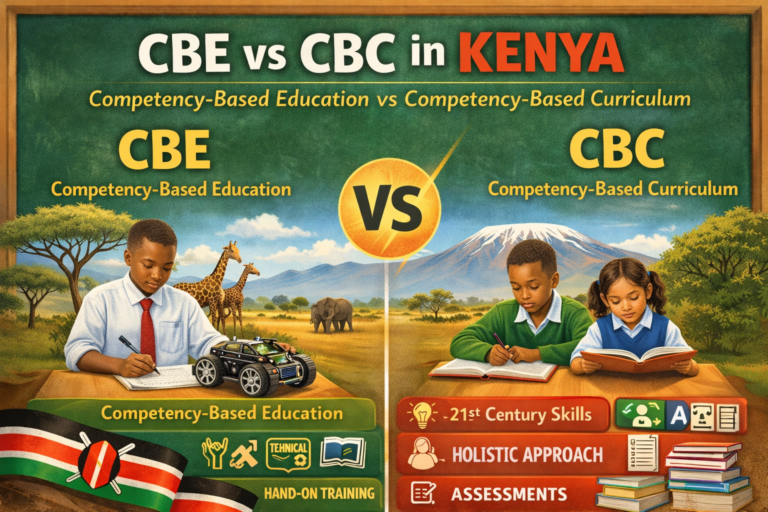
CBC Grading System in Kenya: Complete Guide to Assessment and Scoring
Get High Paying Surveys
Earn money online by completing simple surveys. No experience needed.
Start Earning →The CBC grading system in Kenya often confuses parents who grew up with percentage-based report cards. If you’ve looked at your child’s CBC report and wondered what “Exceeding Expectations” or “Approaching Expectations” means, you’re not alone. Many Kenyan parents, teachers, and even students are still learning how this new assessment approach works.
How CBC is graded differs completely from the old 8-4-4 system. Instead of receiving marks out of 100, learners are assessed on specific competencies and skills throughout the term. The CBC assessment methods focus on what learners can actually do with their knowledge, not just what they can memorize for exams. This approach, designed by the Kenya Institute of Curriculum Development (KICD), aims to give a more complete picture of each learner’s abilities and progress.

This guide explains everything about the CBC grading system—from how teachers assess learners daily to what those assessment ratings really mean for your child’s education and future.
Understanding CBC Grading Explained
What Makes CBC Grading Different
The CBC grading system in Kenya moves away from the traditional percentage scores (like 75% or 82%) that Kenyan parents know well. Instead, CBC uses descriptive ratings that show how well a learner has mastered specific competencies.
This change reflects a fundamental shift in educational philosophy. Rather than comparing children against each other through rankings, CBC measures each child against expected learning outcomes. The question isn’t “Is this child better than others?” but “Has this child developed the skills and knowledge they need at this level?”
The Four Performance Levels
CBC uses four main performance ratings:
Get High Paying Surveys
Earn money online by completing simple surveys. No experience needed.
Start Earning →
1. Exceeding Expectations (EE) The learner demonstrates exceptional understanding and can apply skills independently in new situations. They go beyond what’s required and show creativity or deeper insight.
2. Meeting Expectations (ME) The learner has achieved the expected competencies for their grade level. They understand concepts well and can apply them appropriately.
3. Approaching Expectations (AE) The learner is developing the required competencies but needs more practice and support. They show partial understanding but haven’t fully mastered the skills yet.
4. Below Expectations (BE) The learner has not yet developed the expected competencies. They require significant support and intervention to catch up with grade-level expectations.
These ratings apply to specific learning outcomes, not entire subjects. A child might be “Exceeding Expectations” in one area of Mathematics (like addition) while “Approaching Expectations” in another area (like word problems).
CBC Assessment Methods
Types of Assessment in CBC
The CBC system uses multiple assessment methods to build a complete picture of each learner’s abilities. Understanding these methods helps parents and students know what to expect.
Get High Paying Surveys
Earn money online by completing simple surveys. No experience needed.
Start Earning →
Formative Assessment
What It Is Formative assessment happens continuously during lessons. Teachers observe how learners participate, ask questions, complete activities, and interact with learning materials. This ongoing evaluation helps teachers adjust their teaching to meet learners’ needs.
How It Works in Kenyan Classrooms During a Science lesson about plants, a teacher might:
- Observe which learners correctly identify plant parts during a nature walk
- Listen to group discussions about plant growth
- Check individual drawings of plants to see if learners can label parts correctly
- Ask oral questions to gauge understanding
Teachers don’t always record formal marks for formative assessment. Instead, they use it to identify who needs extra help and who’s ready to move forward.
Get High Paying Surveys
Earn money online by completing simple surveys. No experience needed.
Start Earning →Summative Assessment
What It Is Summative assessment happens at specific points—usually mid-term and end of term—to evaluate what learners have learned over a period. These are the more formal tests and examinations that appear on report cards.
How It’s Conducted Summative assessments include:

- Written tests covering topics learned during the term
- Practical demonstrations (like performing a science experiment)
- Oral presentations or interviews
- Projects completed over several weeks
- Portfolio reviews showing accumulated work
Unlike formative assessment, summative assessment results are recorded formally and appear in learner report forms.
Portfolio Assessment
What It Is Each learner maintains a portfolio—a collection of their work throughout the term. This might include drawings, written work, project photos, and other evidence of learning.
Why It Matters Portfolios show growth over time. A parent can see how their child’s handwriting improved from Term 1 to Term 3, or how their art projects became more detailed. This visual record of progress helps everyone—parents, teachers, and learners—see development that a single exam score cannot capture.
Self-Assessment and Peer Assessment
What It Is CBC encourages learners to evaluate their own work and sometimes assess their classmates’ work. This might involve checking if they’ve met criteria on a rubric or reflecting on what they learned.
Benefits When learners assess themselves, they develop critical thinking and become more aware of their own learning. They learn to identify strengths and areas needing improvement, building independence and responsibility.
How CBC Scores Work
The Rubric System
Teachers use rubrics—scoring guides that describe what each performance level looks like for specific tasks. A rubric for a Grade 5 writing assignment might look like this:
Exceeding Expectations:
- Uses varied sentence structures and advanced vocabulary
- Organizes ideas clearly with introduction, body, and conclusion
- Makes few or no grammar and spelling errors
- Shows creativity and original thinking
Meeting Expectations:
- Uses appropriate sentence structures and vocabulary for grade level
- Organizes ideas logically
- Makes minor grammar and spelling errors that don’t affect meaning
- Completes all required elements of the assignment
Approaching Expectations:
- Uses simple sentences and basic vocabulary
- Shows some organization but ideas may be unclear
- Makes several grammar and spelling errors
- Misses some required elements
Below Expectations:
- Uses very limited vocabulary
- Lacks clear organization
- Makes many errors that affect understanding
- Completes only minimal parts of the assignment
Rubrics make grading more objective and help learners understand exactly what’s expected.
Competency-Based Scoring
CBC doesn’t grade subjects as single units. Instead, each subject is broken down into specific competencies or learning outcomes. For example, Grade 3 Mathematics might include competencies like:
- Can count and write numbers up to 1,000
- Can add and subtract three-digit numbers
- Can identify and continue number patterns
- Can measure length using standard units
- Can read and interpret simple graphs
Each competency receives its own rating (EE, ME, AE, or BE). This detailed approach shows exactly what a child can and cannot do, making it easier to provide targeted support.
Weighting and Overall Scores
While individual competencies are rated separately, schools may provide an overall subject rating for report cards. This overall rating considers:
- Multiple competency ratings within that subject
- Both formative and summative assessment results
- Portfolio evidence
- Practical demonstrations
However, the specific competency ratings remain the most important information for understanding a learner’s actual abilities.
CBC Assessment Methods Across Different Levels
Pre-Primary (PP1 and PP2)
Assessment at pre-primary focuses entirely on observation and play-based activities. Teachers note how children:
- Interact with others during group activities
- Manipulate learning materials (blocks, crayons, puzzles)
- Follow instructions
- Express themselves verbally
- Show physical development (running, jumping, coordination)
There are no written exams at this level. Assessment reports describe developmental milestones and social-emotional growth.
Lower Primary (Grades 1-3)
Assessment begins to include more structured activities but remains largely practical and observation-based. Teachers use:
- Oral questions and answers
- Hands-on activities (counting objects, identifying shapes)
- Simple written exercises (writing letters, basic calculations)
- Art and craft projects
- Physical education activities
- Music and movement exercises
Written tests are short and simple, appropriate for young learners’ abilities.
Upper Primary (Grades 4-6)
Assessment becomes more formal but still balances different methods:
- Written tests covering learned content
- Practical assignments and projects
- Group work and presentations
- Science experiments and demonstrations
- Technology-based activities (where resources allow)
- Continuous observation of class participation
Learners begin taking more responsibility for their learning, including self-assessment and maintaining organized portfolios.
Junior Secondary (Grades 7-9)
Assessment at this level prepares learners for more specialized study:
- Subject-specific tests and examinations
- Extended projects requiring research
- Practical work in sciences, agriculture, and technical subjects
- Creative assignments in arts and languages
- Fieldwork and community-based activities
- Career-related assessments to guide pathway choices
The Kenya Junior Secondary Education Assessment (KJSEA) at the end of Grade 9 is a more formal examination that helps place learners into appropriate senior secondary pathways.
Reading and Understanding CBC Report Cards
What You’ll See on the Report
CBC report forms differ significantly from old 8-4-4 reports. Instead of columns with marks and positions, you’ll find:
Learning Area/Subject Listed at the top, like “Mathematics Activities” or “English Language Activities”
Specific Competencies or Strands Under each subject, you’ll see several specific skills or knowledge areas assessed separately
Performance Rating Each competency shows EE, ME, AE, or BE
Teacher’s Comment A brief description of the learner’s progress and areas needing attention
Overall Subject Rating Sometimes provided as a summary, though individual competencies are more important
Sample Report Entry
Mathematics Activities – Grade 4, Term 2
Numbers and Number Operations:
- Can add and subtract four-digit numbers: Meeting Expectations
- Can multiply two-digit numbers by one-digit numbers: Exceeding Expectations
- Can solve word problems involving division: Approaching Expectations
Measurements:
- Can measure length using centimeters and meters: Meeting Expectations
- Can tell time using both 12-hour and 24-hour formats: Meeting Expectations
Teacher’s Comment: “The learner shows strong computational skills, especially in multiplication. Needs more practice with division word problems. Encourage regular practice at home.”
Overall Mathematics Rating: Meeting Expectations
Interpreting Your Child’s Report
When reviewing your child’s CBC report:
Look at individual competencies first, not just the overall rating. Your child might be strong in some areas while needing support in others.
Compare to previous terms to see growth. A child who moved from “Approaching Expectations” to “Meeting Expectations” in a competency has made excellent progress.
Read teacher comments carefully. These provide context and specific guidance on how to help at home.
Don’t compare children. CBC doesn’t rank learners against each other. Your child’s “Meeting Expectations” means they’re progressing appropriately, regardless of what other children scored.
Meet with teachers if anything is unclear. Teachers can explain specific competencies and suggest ways to support your child’s learning.
Common Concerns About CBC Grading
“How Do I Know if My Child Is Doing Well?”
In 8-4-4, parents could look at a percentage and immediately know: 80% means doing well, 50% means struggling. CBC requires more interpretation, which can feel uncertain.
Understanding “Meeting Expectations” If your child consistently receives “Meeting Expectations” across competencies, they are doing well. This rating means your child has mastered what’s required for their grade level. It’s not “average” in the old sense—it’s exactly where they should be.
When to Worry “Approaching Expectations” in several competencies indicates your child needs additional support. “Below Expectations” requires immediate intervention—contact the teacher to create a support plan.
When to Celebrate “Exceeding Expectations” means your child goes beyond grade-level requirements. This doesn’t mean they should skip grades, but it suggests they might benefit from enrichment activities in those areas.
“Is There No Competition?”
Some parents worry that CBC eliminates healthy competition. Actually, CBC shifts the focus from competing against others to competing against one’s own previous performance.
Learners still have goals to reach and can track their own progress. Instead of asking “Am I better than others?” they learn to ask “Am I better than I was last term?” This builds intrinsic motivation and lifelong learning habits.
“How Will This Affect University Admission?”
This concern is valid, especially for the first CBC cohorts. However, universities in Kenya are adjusting admission criteria to work with CBC grades. The Kenya Universities and Colleges Central Placement Service (KUCCPS) will develop placement systems that recognize CBC’s competency-based approach.
Additionally, CBC’s emphasis on multiple pathways means not every learner needs to pursue traditional university degrees. Technical colleges, vocational training, and other tertiary options will be equally valued.
“Can Teachers Grade Fairly Without Percentages?”
Teachers receive training on using rubrics and assessment criteria to grade consistently. Rubrics actually make grading more objective than percentage systems, where two teachers might give different marks for the same essay.
However, implementing new assessment methods takes time. Some teachers are still developing comfort with CBC grading, and ongoing professional development remains important.
What Parents Should Do
Supporting Your Child Based on Their Grades
For “Exceeding Expectations” Learners
- Provide enrichment activities to keep them challenged
- Encourage deeper exploration of topics they love
- Consider clubs, competitions, or additional reading materials
- Avoid putting pressure to always exceed—it’s okay to sometimes just meet expectations
For “Meeting Expectations” Learners
- Celebrate their success—they’re exactly where they need to be
- Continue supporting homework and school projects
- Encourage consistent effort and good study habits
- Help them explore interests and talents in all learning areas
For “Approaching Expectations” Learners
- Work closely with teachers to understand specific challenges
- Provide additional practice in weak areas without overwhelming your child
- Celebrate small improvements—moving from BE to AE is significant progress
- Consider if learning difficulties or other factors need attention
- Be patient—children develop at different rates
For “Below Expectations” Learners
- Request a meeting with the teacher immediately
- Understand the specific competencies your child struggles with
- Develop a home-school intervention plan
- Consider if your child needs assessment for learning difficulties
- Provide emotional support—avoid making your child feel inadequate
- Track progress regularly and adjust strategies as needed
Creating a Supportive Home Environment
Review Reports Together Sit with your child and go through the report together. Ask them how they feel about each rating and what they think they can improve.
Set Realistic Goals Help your child set one or two specific goals for the next term based on their report. “I will practice my multiplication tables every day” is more useful than “I will do better in maths.”
Communicate with Teachers Don’t wait for report day. Maintain regular contact with your child’s teacher to stay informed about progress and challenges.
Value All Competencies CBC assesses more than just academic subjects. Celebrate growth in creativity, sports, collaboration, and other competencies equally.
What Teachers Should Know
Effective CBC Assessment Practices
Plan Assessment Into Every Lesson Don’t treat assessment as something separate from teaching. Every activity provides assessment information if you’re observing purposefully.
Use Varied Assessment Methods Different learners demonstrate competencies in different ways. Some excel in written tests, others in practical demonstrations or oral presentations. Use multiple methods to ensure fairness.
Keep Organized Records Maintain clear, organized records of formative and summative assessments. Digital tools or simple spreadsheets can help track individual learner progress across competencies.
Provide Timely Feedback Give learners feedback while learning is happening, not just at report time. Immediate feedback helps them improve before summative assessment.
Involve Learners in Assessment Teach learners to use rubrics to assess their own work. This builds metacognitive skills and helps them understand what quality work looks like.
Writing Helpful Report Comments
Good teacher comments:
- Are specific (“Excellently adds three-digit numbers”) rather than vague (“Good at maths”)
- Acknowledge progress (“Has improved in reading comprehension since last term”)
- Provide actionable guidance (“Practice spelling common words at home”)
- Balance praise with constructive suggestions
- Use language parents can understand
Avoid:
- Comparing learners to each other
- Using educational jargon without explanation
- Being discouraging or negative
- Making comments too brief to be useful
What Students Should Know
Understanding Your Own Progress
Your Ratings Show Growth, Not Worth A rating of “Approaching Expectations” doesn’t mean you’re not smart or capable. It means you’re still developing that skill, and that’s normal. Everyone learns at their own pace.
Focus on Specific Competencies Instead of worrying about your overall grade, look at exactly which skills you’ve mastered and which need more work. This helps you know where to focus your efforts.
Ask Questions If you don’t understand why you received a particular rating, ask your teacher to explain. Understanding assessment helps you improve.
Track Your Own Progress Keep your portfolio organized. Look back at your work from earlier terms to see how much you’ve grown. This builds confidence and motivation.
Participate in Self-Assessment When teachers ask you to assess your own work, take it seriously. This helps you become an independent learner who can identify strengths and weaknesses without always needing a teacher.
Frequently Asked Questions (FAQs)
What does Exceeding Expectations mean in CBC?
Exceeding Expectations (EE) means a learner has gone beyond the grade-level requirements for a particular competency. They demonstrate exceptional understanding, can apply skills in new situations independently, and often show creativity or deeper insight than expected at their level. It’s similar to scoring in the 80-100% range in the old system, but specifically indicates mastery beyond minimum requirements.
How are CBC scores calculated?
CBC scores are calculated by assessing learners against specific competencies using rubrics. Teachers consider multiple forms of evidence including formative assessment (daily observations and activities), summative assessment (tests and exams), portfolio work, practical demonstrations, and projects. Each competency receives a rating (EE, ME, AE, or BE), and these may be combined into an overall subject rating using professional judgment about the learner’s typical performance level.
Is Meeting Expectations good or bad in CBC?
Meeting Expectations (ME) is good—it means your child has successfully learned what’s required for their grade level. In CBC, ME is the target rating, showing appropriate progress and competency development. It doesn’t mean “average” in the old competitive sense. A learner who consistently meets expectations across all subjects is doing exactly what they should be doing and is well-prepared for the next grade level.
Can a CBC student fail a grade?
Yes, a learner can repeat a grade in CBC if they show “Below Expectations” in multiple critical competencies and haven’t developed fundamental skills needed for the next level. However, CBC emphasizes continuous support and intervention rather than retention. Teachers work with struggling learners throughout the year to help them reach at least “Approaching Expectations” in most areas before considering repetition. The decision involves teachers, parents, and school administration.
How do CBC assessment methods differ from 8-4-4?
CBC assessment methods differ from 8-4-4 in several key ways: CBC uses continuous assessment throughout the term rather than relying mainly on end-of-term exams; it assesses specific competencies instead of giving one overall subject mark; it employs multiple assessment types including observation, portfolios, practical work, and projects alongside written tests; it uses descriptive ratings (EE, ME, AE, BE) instead of percentages; and it measures learners against expected outcomes rather than ranking them against classmates.
What should I do if my child is Below Expectations in CBC?
If your child receives Below Expectations (BE) ratings, immediately schedule a meeting with their teacher to understand the specific challenges. Work together to create an intervention plan that may include additional practice at home, peer tutoring, extra support sessions at school, or assessment for learning difficulties if needed. Track progress regularly, celebrate small improvements, and provide emotional support without making your child feel inadequate. With consistent intervention, most learners can move from BE to AE or higher.
Conclusion
The CBC grading system in Kenya represents a fundamental shift in how we measure learning and success. While it may feel unfamiliar to parents who grew up with percentage-based report cards, understanding how CBC is graded reveals a more comprehensive and fair approach to assessment.
Through varied CBC assessment methods—including formative assessment, summative tests, portfolios, and practical demonstrations—the system builds a complete picture of each learner’s abilities. The competency-based ratings (Exceeding Expectations, Meeting Expectations, Approaching Expectations, Below Expectations) provide specific, actionable information about what learners can do, not just how they compare to others.
With CBC grading explained in practical terms, parents can better interpret report cards, support their children appropriately, and celebrate genuine progress. Teachers can implement fair, consistent assessment practices that truly measure competency development. And students can understand their own growth, focusing on mastering skills rather than simply chasing high marks.
As Kenya continues implementing CBC, understanding CBC scores and assessment helps everyone—parents, teachers, and learners—work together effectively. The goal isn’t perfection in every competency but steady growth, development of essential skills, and preparation for successful futures in whatever paths learners choose.
The CBC grading system may require adjustment, but its focus on what learners can actually do makes it a more meaningful measure of education than any percentage could ever be.
Get High Paying Surveys
Earn money online by completing simple surveys. No experience needed.
Start Earning →