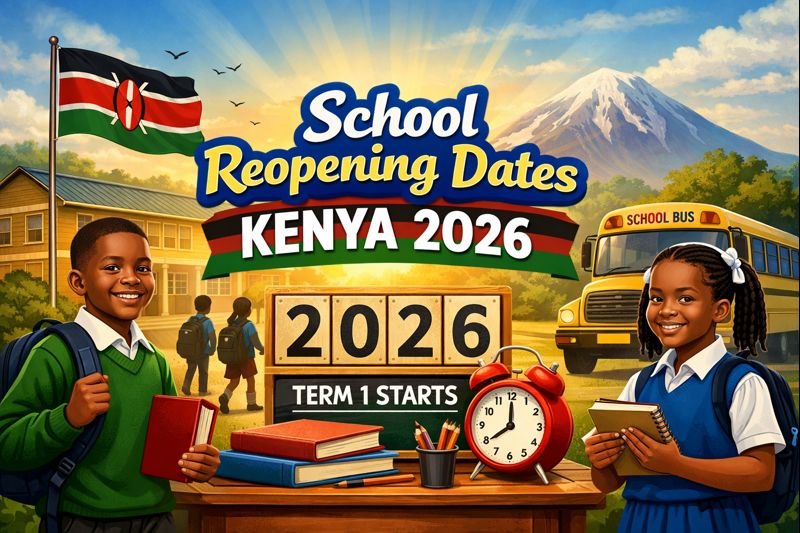
School Reopening Dates Kenya 2026: Official Term One Reporting Day and Full Academic Calendar
Get High Paying Surveys
Earn money online by completing simple surveys. No experience needed.
Start Earning →The Ministry of Education has confirmed that schools across Kenya will officially reopen for the 2026 academic year on Monday, January 6, 2026, following the conclusion of the December holiday break. The announcement, made through a circular signed by Basic Education Principal Secretary Julius Bitok and addressed to Education Cabinet Secretary Julius Ogamba, provides clear guidance for the January school opening Kenya and the complete calendar for all three terms.
This year’s reopening is particularly significant as it marks the historic transition of the first cohort of learners under the Competency-Based Education system into senior secondary schools. With schools opening next week, millions of students, parents, and teachers are making final preparations for what promises to be a transformative academic year for Kenya’s education sector.

Ministry of Education Reopening Notice: What Has Been Officially Announced
According to the official Ministry of Education reopening notice, all basic education institutions including pre-primary, primary, junior secondary, and senior secondary schools will commence Term One on Monday, January 6, 2026. This universal reopening date applies to both public and private schools across all 47 counties.
However, the Ministry has established a staggered reporting system for different categories of learners. While most students return on January 6, the inaugural Grade 10 cohort transitioning to senior secondary schools under the Competency-Based Curriculum will report one week later, on Monday, January 12, 2026.
This differentiated timeline allows senior secondary schools additional time to prepare adequate infrastructure, finalize placements, and ensure smooth admission processes for the pioneer CBC cohort. The Ministry processed placement for 1,130,459 learners who sat for the Kenya Junior School Education Assessment in 2025, comprising 578,630 boys and 551,829 girls.
Principal Secretary Bitok directed all regional, county, and sub-county directors of education to distribute the circular to every learning institution under their jurisdiction. The document was also copied to the Teachers Service Commission and the Kenya National Examinations Council to ensure coordinated implementation across the education sector.
Get High Paying Surveys
Earn money online by completing simple surveys. No experience needed.
Start Earning →
To support the reopening, the government has released Ksh44,245,066,500.85 as Term One capitation funds. These resources have been distributed across primary schools, junior secondary schools, and day secondary schools to cover operational costs for the first term of 2026.
Complete 2026 Term Dates and Academic Calendar
The 2026 academic calendar maintains the traditional three-term structure that has guided Kenya’s education system for decades. Each term includes specific opening dates, mid-term breaks, closing dates, and examination periods designed to optimize learning while providing adequate rest for students.
Term One 2026:
The first term will span 13 weeks, beginning on January 6, 2026, and ending on April 2, 2026. Students will enjoy a five-day mid-term break scheduled from February 25 to March 1, 2026, allowing them to rest halfway through the term.
Following the closure on April 2, schools will proceed on a three-week April holiday from April 7 to April 24, 2026. This break gives learners time to rest and teachers opportunity to prepare for the second term.
Term Two 2026:
Get High Paying Surveys
Earn money online by completing simple surveys. No experience needed.
Start Earning →
The second term represents the longest learning period in the 2026 academic calendar. It will run for 14 weeks, commencing on April 27, 2026, and concluding on July 31, 2026.
A half-term break has been scheduled for five days from June 24 to June 28, 2026. After closing on July 31, students will enjoy a two-week August holiday running from August 4 to August 21, 2026, before reporting back for the final term.
Term Three 2026:
Get High Paying Surveys
Earn money online by completing simple surveys. No experience needed.
Start Earning →The third and final term is the shortest, lasting nine weeks to accommodate national examinations. It begins on August 24, 2026, and ends on October 23, 2026.
Immediately following the term closure, national examinations commence. The Kenya Primary School Education Assessment and Kenya Intermediate Level Education Assessment will begin on October 26, 2026, and run for five days.

The Kenya Junior School Education Assessment and Kenya Pre-Vocational Level Education Assessment will also start on October 26, spanning seven days. The Kenya Certificate of Secondary Education examinations will take place over three weeks, from November 2 to November 20, 2026.
After examinations conclude, learners will break for the long December holiday, which will last 10 weeks from October 26, 2026, to January 1, 2027.
Summary Table of 2026 Term Dates:
| Term | Opening Date | Mid-Term Break | Closing Date | Holiday Duration |
|---|---|---|---|---|
| Term One | January 6, 2026 | Feb 25 – Mar 1 | April 2, 2026 | 3 weeks (Apr 7-24) |
| Term Two | April 27, 2026 | June 24 – 28 | July 31, 2026 | 2 weeks (Aug 4-21) |
| Term Three | August 24, 2026 | None | October 23, 2026 | 10 weeks (Oct 26 – Jan 1, 2027) |
Term One Reporting Day: What Students Need to Know
The term one reporting day varies depending on the level of education and the curriculum pathway. Understanding these distinctions helps parents and students prepare appropriately for the new academic year.
Regular Students (Pre-Primary to Grade 9 and Form 1-4):
All learners in pre-primary, primary schools, junior secondary schools (Grades 7-9), and senior secondary schools (Forms 1-4) should report to their respective institutions on Monday, January 6, 2026. This applies nationwide to both day scholars and boarding students.
Parents should ensure their children arrive at school with all required materials, including textbooks, exercise books, uniforms, and any specific items requested by individual schools. Boarding students should additionally pack personal effects, bedding, and toiletries as specified in their school’s requirements list.
Grade 10 Students (CBC Senior Secondary):
The inaugural Grade 10 cohort transitioning to senior secondary schools under the Competency-Based Education system will report one week later, on Monday, January 12, 2026. This delayed reporting applies to all 1,130,459 learners who completed the Kenya Junior School Education Assessment in 2025 and received placement letters.
Grade 10 students must bring their official placement letters downloaded from the Ministry of Education portal, KJSEA result slips, birth certificates or national identification cards, and any additional documents specified by their new schools. Boarding students should prepare uniforms, bedding, and personal items according to school-specific lists.
The Ministry has emphasized that all Grade 10 admissions must be processed through the Kenya Education Management Information System. School principals are prohibited from enrolling any learner into KEMIS before the student physically reports to the school on the designated reporting date.
Historic Grade 10 Transition Under Competency-Based Curriculum
January 2026 marks a watershed moment in Kenya’s education history as the first cohort of learners transitions from junior secondary school to senior secondary school under the Competency-Based Curriculum. This transition represents the culmination of years of planning, investment, and reform aimed at transforming how Kenyan students learn.
The 1,130,459 Grade 10 students will join 9,540 senior secondary schools across the country, with a combined capacity of 2.2 million learners. With only three grade levels (10, 11, and 12) hosted at the senior secondary level, schools have additional classroom space compared to the previous four-year secondary cycle.
Senior secondary education under CBC emphasizes practical skills, critical thinking, and career pathway specialization. Each learner will study seven subjects, including four compulsory core areas: English, Kiswahili, Core or Essential Mathematics, and Community Service Learning, alongside three elective subjects aligned to their chosen career pathways.
Students selected pathways during their junior secondary years, choosing between STEM (Science, Technology, Engineering, and Mathematics), Social Sciences, or Arts and Sports Sciences. These choices guided their placement into appropriate senior secondary schools offering programs aligned with their interests and career aspirations.
The placement process considered multiple factors, including learner performance in KJSEA, psychometric test results, student preferences, equity considerations, and school capacity. The Ministry employed the Commission on Revenue Allocation formula to ensure fair distribution of opportunities across all counties.
What Parents Should Do Before January School Opening Kenya
With schools reopening next week, parents must complete several critical tasks to ensure their children begin the term smoothly and without unnecessary delays or complications.
Verify Reporting Information:
Confirm your child’s school, reporting date, and reporting time by checking official communication from the school or the Ministry of Education. For Grade 10 students, download and print the placement letter from the Ministry’s portal at placements.education.go.ke.
Prepare Required Documents:
Gather all necessary documentation, including report cards or result slips from the previous academic year, birth certificates or identification documents, immunization records if required, and any school-specific forms or consent documents. Grade 10 students must have their KJSEA result slips and official placement letters.
Purchase Uniforms and Learning Materials:
Buy or prepare school uniforms according to your child’s school specifications. Purchase required textbooks, exercise books, pens, pencils, mathematical instruments, and other learning materials. Many schools provide book lists at the end of the previous term or on their websites.
Arrange School Fees and Transport:
Plan for school fees payment, particularly the first installment due at the beginning of the term. Different school categories have varying fee structures, with former national schools (C1 institutions) charging up to Ksh53,554 annually for boarding. Arrange reliable transport for your child, especially if they attend a day school requiring daily commuting.
Health and Wellness Preparation:
Ensure your child is in good health before school resumes. Address any medical issues requiring attention and stock up on any prescribed medications. For boarding students, pack adequate toiletries, personal hygiene products, and any health-related items they might need during the term.
Communicate with Your Child:
Discuss expectations for the new term with your child, addressing any concerns or anxieties they may have. Encourage a positive attitude toward learning and help them set realistic academic and personal goals for 2026.
Grade 10 Placement Review Process: Second Window Opens
For parents seeking to change their child’s Grade 10 placement, the Ministry has opened a second review window running from January 6 to January 9, 2026. This four-day period allows families to request placement changes before the official reporting date on January 12.
The review process operates entirely through digital systems, with requests initiated through specific channels. Parents cannot directly submit placement change requests. Instead, requests must be initiated either through the learner’s former junior school or at the senior school of interest.
The Head of Institution at either the junior school or the senior school must submit the request on the Ministry’s placement portal. This institutional-level submission ensures proper verification and maintains accountability throughout the process.
Each learner is allowed only one placement revision. Once a new placement letter is generated following approval, the decision becomes final and irreversible. This policy underscores the importance of carefully considering all factors before requesting a change.
The Ministry completed the first revision of Grade 10 placements on December 29, 2025, with joining instructions becoming available on the placement portal from December 30. The second review window represents the final opportunity for placement adjustments before schools reopen.
Parents should note that placement reviews require legitimate and verifiable grounds for reconsideration. Factors such as health conditions, family circumstances, or specific educational needs may justify review requests, but preferences alone may not constitute sufficient grounds.
National Examinations Schedule for 2026
The 2026 academic calendar includes clearly defined dates for all national examinations administered across different education levels. These examinations play critical roles in assessment, certification, and transition within the Kenyan education system.
October 2026 Examinations:
The Kenya Primary School Education Assessment and Kenya Intermediate Level Education Assessment will begin simultaneously on October 26, 2026, and run for five days until October 30. These assessments evaluate learners at primary level under the CBC framework.
The Kenya Junior School Education Assessment and Kenya Pre-Vocational Level Education Assessment will also commence on October 26, spanning seven days until November 3, 2026. These assessments test learners completing junior secondary school and prepare them for senior secondary placement.
November 2026 KCSE:
The Kenya Certificate of Secondary Education examination, which remains the primary certification for the 8-4-4 system learners still in the pipeline, will run for three weeks. KCSE candidates will sit their examinations from November 2 to November 20, 2026.
This represents one of the final KCSE examination cohorts as the education system gradually transitions fully to the Competency-Based Curriculum. Students currently in Forms 2 and 3 will still complete their secondary education under the 8-4-4 structure.
Schools Operating Schedule and Daily Timetables
The Ministry has established standardized operating schedules for senior secondary schools under the CBC framework, ensuring consistency across the country while allowing some flexibility for institutional contexts.
Senior secondary learners will attend 40 lessons per week, with each lesson lasting 40 minutes. The school day begins with reporting time at 8:00 a.m., allowing students to settle before formal instruction begins.
Formal lessons run from 8:20 a.m. to 3:20 p.m., structured around break periods designed to support learner well-being and concentration. A 10-minute break follows the first two lessons, allowing students brief rest and refreshment.
After the next two lessons, students enjoy a 30-minute break for snacks and socialization. A one-hour lunch break provides adequate time for meals and relaxation during the middle of the school day.
Non-formal programs, including clubs, sports, music, drama, and other co-curricular activities, are scheduled after 3:20 p.m. These programs complement academic learning by developing practical skills, talents, and social competencies emphasized in the CBC framework.
Restrictions on School Activities During Third Term
The Ministry has maintained existing restrictions affecting secondary schools during the third term of 2026. According to the official circular, activities and visits to secondary schools in Term Three remain banned as per earlier directives.
This prohibition aims to minimize disruptions during the crucial examination period when students need focused preparation time. The policy prevents unauthorized visitors, commercial activities, and non-essential events that might interfere with learning and examination administration.
Schools must comply with these restrictions to ensure learners have optimal conditions for final term studies and national examinations. The Ministry expects regional and county education officials to enforce these guidelines strictly across all institutions.
Diploma Teachers Training Colleges Academic Calendar
Diploma Teachers Training Colleges will follow a broadly similar academic calendar to basic education institutions, with some modifications to accommodate their unique training requirements and assessment schedules.
DTTCs will open on the same date as other schools, beginning Term One on January 6, 2026. However, their third term will be longer than that of basic education institutions, running for 11 weeks and ending on November 6, 2026.
The extended third term for teacher training colleges allows adequate time for teaching practice, assessments, and certification processes required for diploma teacher preparation. After the term concludes, DTTC students will proceed on their December holiday beginning November 9, 2026.
This calendar ensures that trainee teachers complete all required competencies and practical experiences before certification, maintaining quality standards in teacher preparation across the country.
What This Means for Kenya’s Education System
The 2026 school reopening represents more than just the start of another academic year. It marks a critical juncture in Kenya’s ongoing education transformation, with profound implications for how future generations will learn and prepare for careers.
The simultaneous operation of two education systems—the phased-out 8-4-4 structure and the emerging Competency-Based Curriculum—requires careful resource management and coordination. Schools must accommodate learners at different stages of both systems while ensuring quality education for all.
The government’s release of over Ksh44 billion in Term One capitation demonstrates commitment to supporting schools through this complex transition period. These funds help institutions meet operational costs, maintain facilities, and provide quality learning environments despite the challenges of managing multiple curricula.
Infrastructure expansion continues as a priority, with the government having constructed 23,000 classrooms and planning for 1,600 laboratories in senior schools. The recruitment of 100,000 teachers since 2023, including 24,000 hired this year and 25,000 promoted, aims to improve teacher-student ratios and instructional quality.
However, significant challenges remain. Regional disparities in school performance and resource distribution persist, requiring targeted interventions to ensure equitable access to quality education. School principals face the complex task of managing transitions while maintaining academic standards and student welfare.
The focus on competency-based learning, career pathways, and practical skills represents a fundamental shift from rote memorization toward critical thinking and application. Success depends on adequate teacher training, sufficient learning resources, and sustained government investment in education infrastructure.
Common Questions About School Reopening Dates Kenya 2026
When do schools officially reopen for Term One 2026?
Schools across Kenya officially reopen on Monday, January 6, 2026, for all pre-primary, primary, junior secondary (Grades 7-9), and senior secondary (Forms 1-4) students. Grade 10 students under CBC will report one week later on Monday, January 12, 2026.
What is the term one reporting day for Grade 10 students?
Grade 10 students transitioning to senior secondary schools under the Competency-Based Curriculum will report on Monday, January 12, 2026. This applies to all 1,130,459 learners who sat for the Kenya Junior School Education Assessment in 2025.
How long is the first term in 2026?
The first term will run for 13 weeks, beginning on January 6, 2026, and ending on April 2, 2026. A five-day mid-term break is scheduled from February 25 to March 1, 2026.
Can parents still change their child’s Grade 10 placement?
Yes, a second placement review window is open from January 6 to January 9, 2026. Requests must be submitted through the junior school or the senior school of interest, and each learner is allowed only one placement revision.
What documents should Grade 10 students bring on reporting day?
Grade 10 students must bring their official placement letter from the Ministry portal, KJSEA result slip, birth certificate or national identification card, and any additional documents specified by their new school.
When will national examinations take place in 2026?
The KPSEA, KILEA, KJSEA, and KPLEA examinations will begin on October 26, 2026. The KCSE examination will run for three weeks from November 2 to November 20, 2026.
How many terms are there in the 2026 academic calendar?
The 2026 academic year maintains the traditional three-term structure. Term One runs for 13 weeks, Term Two for 14 weeks, and Term Three for 9 weeks to accommodate national examinations.
Preparing for a Successful 2026 Academic Year
As schools prepare to reopen next week, the collective responsibility of ensuring student success rests on parents, teachers, school administrators, and education officials. The clarity provided by the Ministry of Education reopening notice allows all stakeholders to plan effectively.
Parents should use the remaining days to complete preparations, addressing any outstanding issues related to fees, uniforms, learning materials, or documentation. Open communication with schools helps resolve potential problems before they affect your child’s education.
Teachers and school administrators face the important task of creating welcoming, organized environments that set positive tones for the academic year. Proper preparation of classrooms, teaching materials, and administrative systems ensures smooth reopening and effective instruction from day one.
Students themselves bear responsibility for approaching the new year with commitment, discipline, and eagerness to learn. Whether continuing familiar routines or starting new chapters at different institutions, maintaining focus on educational goals contributes to individual and collective success.
The 2026 academic year promises significant developments as Kenya’s education transformation continues. With proper preparation, adequate support, and shared commitment to excellence, this year can yield positive outcomes for learners at all levels.
Conclusion
The official school reopening dates Kenya 2026 are now confirmed, with most students returning on Monday, January 6, and Grade 10 students reporting on Monday, January 12. The complete 2026 term dates provide clear guidance for planning throughout the academic year.
This year’s January school opening Kenya carries special significance as the education sector navigates the historic transition to Competency-Based Curriculum while completing the phase-out of the 8-4-4 system. The Ministry of Education reopening notice ensures coordinated implementation across all counties and institutions.
Parents and students should finalize preparations this week, ensuring all requirements are met before the term one reporting day arrives. With proper planning, adequate resources, and collaborative effort, the 2026 academic year can deliver quality education and positive outcomes for Kenya’s learners.
For official updates and clarifications, parents should regularly check the Ministry of Education website and maintain contact with their children’s schools through established communication channels.
Get High Paying Surveys
Earn money online by completing simple surveys. No experience needed.
Start Earning →